Which surface are you leaning toward for your patio?
The compare pages set each of these against the others.
No votes yet. Yours will be the first. · saved on this device
Loading...
Patio Scopebook · Materials
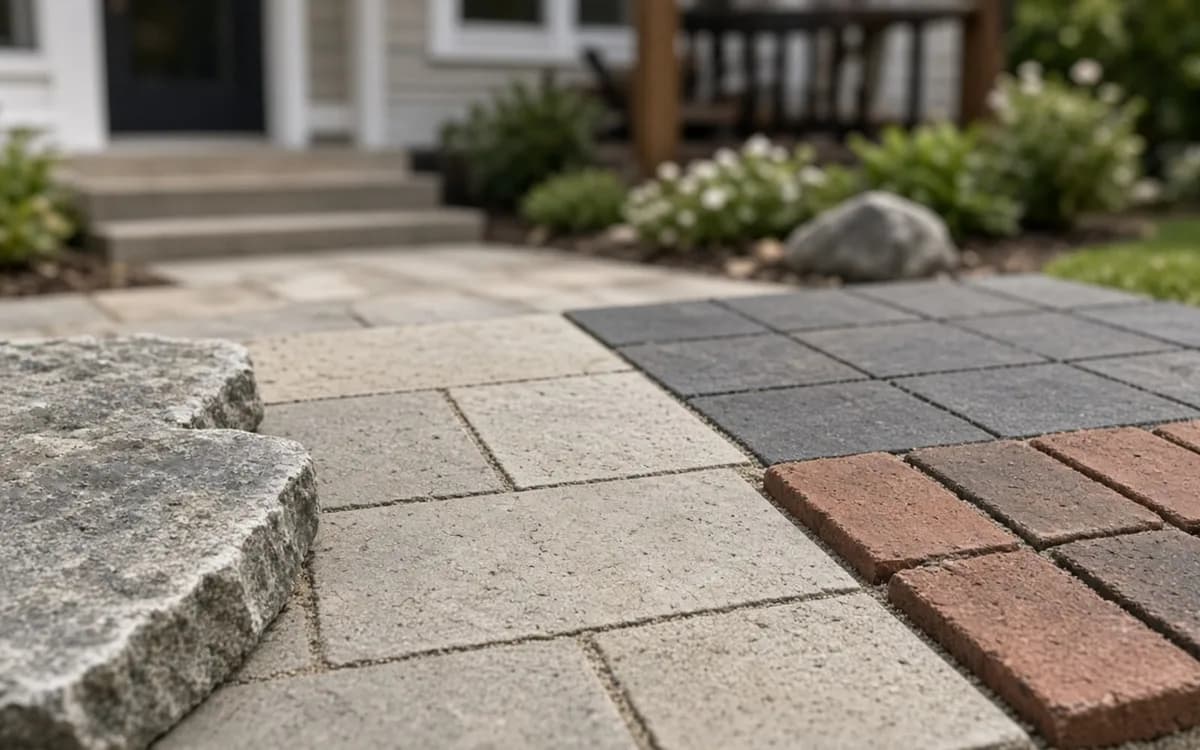
Concrete pavers suit most yards because they are affordable, uniform and can be lifted and relaid. Poured concrete is cheapest and fastest but cracks and cannot be spot-repaired. Natural stone lasts indefinitely and looks unique at a premium. Permeable pavers solve drainage on wet or regulated lots. Block walls outlast timber; gas fire features trade a line for convenience.
By Patio Scopebook editorial · Updated 2026-09-25
Every hardscape material is a trade between price, repairability, appearance and how it handles water and frost. There is no best surface, only the best fit for a soil, a climate, a budget and how long you plan to stay. This guide sets the main options side by side so that when a professional recommends one, you know what question to ask next. Fit includes the house: Houzz's 2026 outdoor study found 28% of renovators wanted the new space to match the home's style.
It covers patio and walkway surfaces first, then driveway considerations, then retaining wall materials and fire feature fuels. Where the site has a dedicated comparison page, the guide summarises and links to it rather than repeating the table. Costs are cited from the same 2025 and 2026 sources as the cost guide. Choice is not the constraint: Freedonia sizes U.S. demand for hardscaping products at $4.4 billion in 2024, so most supply yards stock several lines of each material.
Concrete pavers are cast in molds to a consistent size and a compressive strength well above poured concrete, which is why they handle freeze-thaw and point loads so well. They are laid dry on a sand bed over compacted stone, so the surface flexes with the ground instead of cracking, and any unit that settles or stains can be lifted and replaced. That repairability is the strongest argument for pavers over a slab.
Their weaknesses are cosmetic and maintenance-related. Early efflorescence is common and weathers off; pigmented surfaces fade slowly in strong sun; joints need polymeric sand and occasional topping up; edges drift if the restraint is skipped. Standard 60 mm units are right for patios and walks; 80 mm units are for driveways. Lawn Love's December 2025 range of $8 to $24 per sq ft covers most installed patios. The pavers versus stone page shows where they lose to stone.
A poured slab is the lowest-cost durable surface and the fastest to install: form, pour, finish, cut control joints and wait a week. The site's calculator prices it at about 60 percent of a paver patio. On stable, well-drained soil in a mild climate a broom-finished slab can last thirty years with little care. Stamped and colored finishes raise the price toward pavers while keeping the slab's limitations.
The limitations are cracking and repair. Concrete shrinks as it cures and moves with the ground; control joints tell it where to crack, but frost heave, tree roots and clay can crack it elsewhere. A cracked or settled slab cannot be lifted; it is patched, mud-jacked or replaced. Fixr's comparison prices a 120 square foot patio at $1,310 to $1,770 vs $865 to $1,085 for pavers versus concrete, and the full comparison weighs that saving against the repair question.
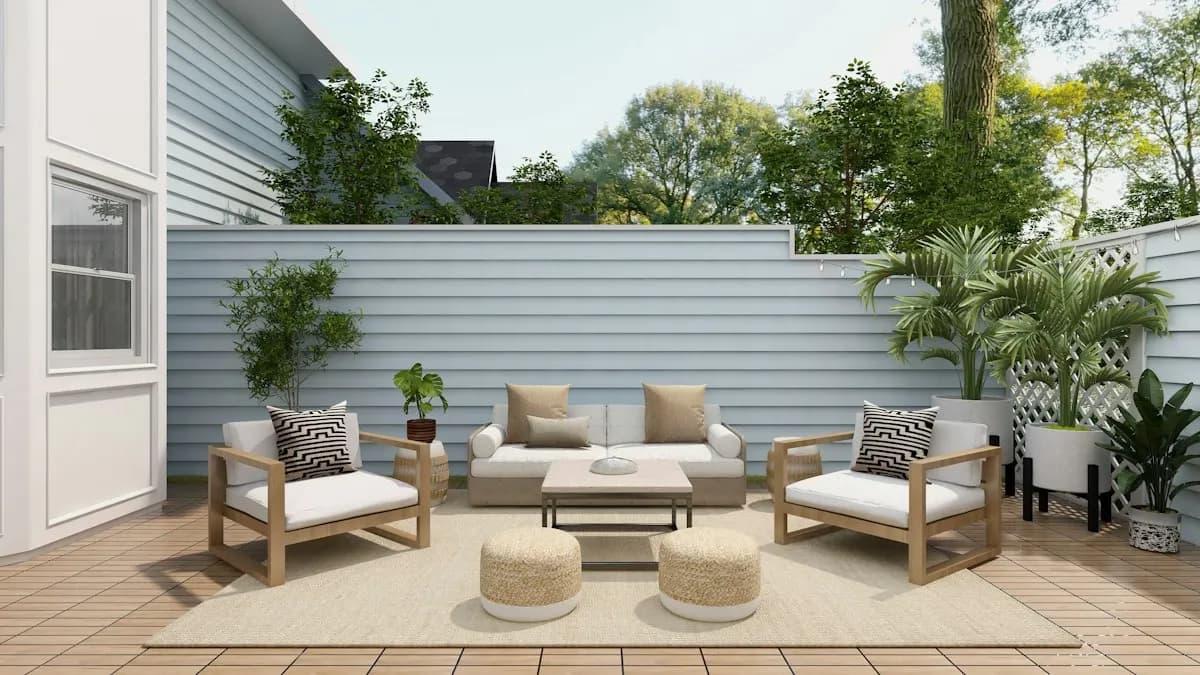
Bluestone, flagstone, limestone, travertine, granite and slate all make patios, but they behave differently. Dense stones such as bluestone and granite resist frost; porous stones such as some limestones and travertine can spall in freeze-thaw unless the grade is chosen for it. Thickness matters more than type for dry-set work: irregular flagstone thinner than an inch and a half breaks under a table leg. Sawn, gauged stone lays like pavers; irregular stone takes far more labor to fit.
Price depends heavily on distance from the quarry. Regional stone often competes with premium concrete pavers, while stone shipped across the country can double the installed cost, which the site's cost table puts at $12 to $30 per square foot. Stone also varies in slip resistance and heat retention: honed travertine stays cool in the sun; dark slate does not. Ask for a full-size sample, wet it, and stand on it before choosing.
| Stone | Frost fit | Notes |
|---|---|---|
| Bluestone | Excellent | Dense, cool-toned, Northeast native, thermal finish is slip-resistant |
| Flagstone (sandstone) | Good if dense | Warm tones, irregular or sawn, thickness is critical |
| Travertine | Fair | Stays cool, porous, choose dense grade for cold climates |
| Limestone | Varies | Soft grades spall, dense grades excellent, salt-sensitive |
| Granite | Excellent | Hardest and heaviest, more expensive to cut and lay |
Both. Permeable interlocking concrete pavers look like conventional pavers but have wider joints filled with small clean stone, laid over an open-graded stone reservoir instead of a dense base. Rain passes through the surface and is stored and infiltrated below. The EPA reports construction at $7 to $14 per sq ft and notes they remove most sediment from runoff, which is why municipalities with stormwater rules often credit them.
They are the right choice where a patio would otherwise need a drain, where impervious cover is capped, or where runoff toward a neighbor or foundation must be stopped. They are the wrong choice on heavy clay that will not infiltrate, unless an underdrain is added, and they need vacuuming of the joints every few years. Virginia Cooperative Extension gives a maintained service life of 20 to 30 years. The permeable comparison covers the base in detail.
Clay brick pavers hold their color permanently because it is fired in, not pigmented, and they suit older houses and formal gardens. They cost more than concrete pavers, at $14 to $24 per square foot installed on the site's table, and must be a true paving brick rated for severe weather; wall brick spalls in frost. Sizes are less uniform than concrete, so patterns take more skill.
Porcelain pavers are a newer option: thin, dense, stain-proof and available in stone looks. They need a very flat base or a pedestal system and chip if dropped, so installer experience matters. Gravel and decomposed granite are inexpensive, permeable and good for paths, but they migrate, need edging and do not suit furniture. Rubber and composite deck tiles over an existing slab are a stopgap, not a hardscape.
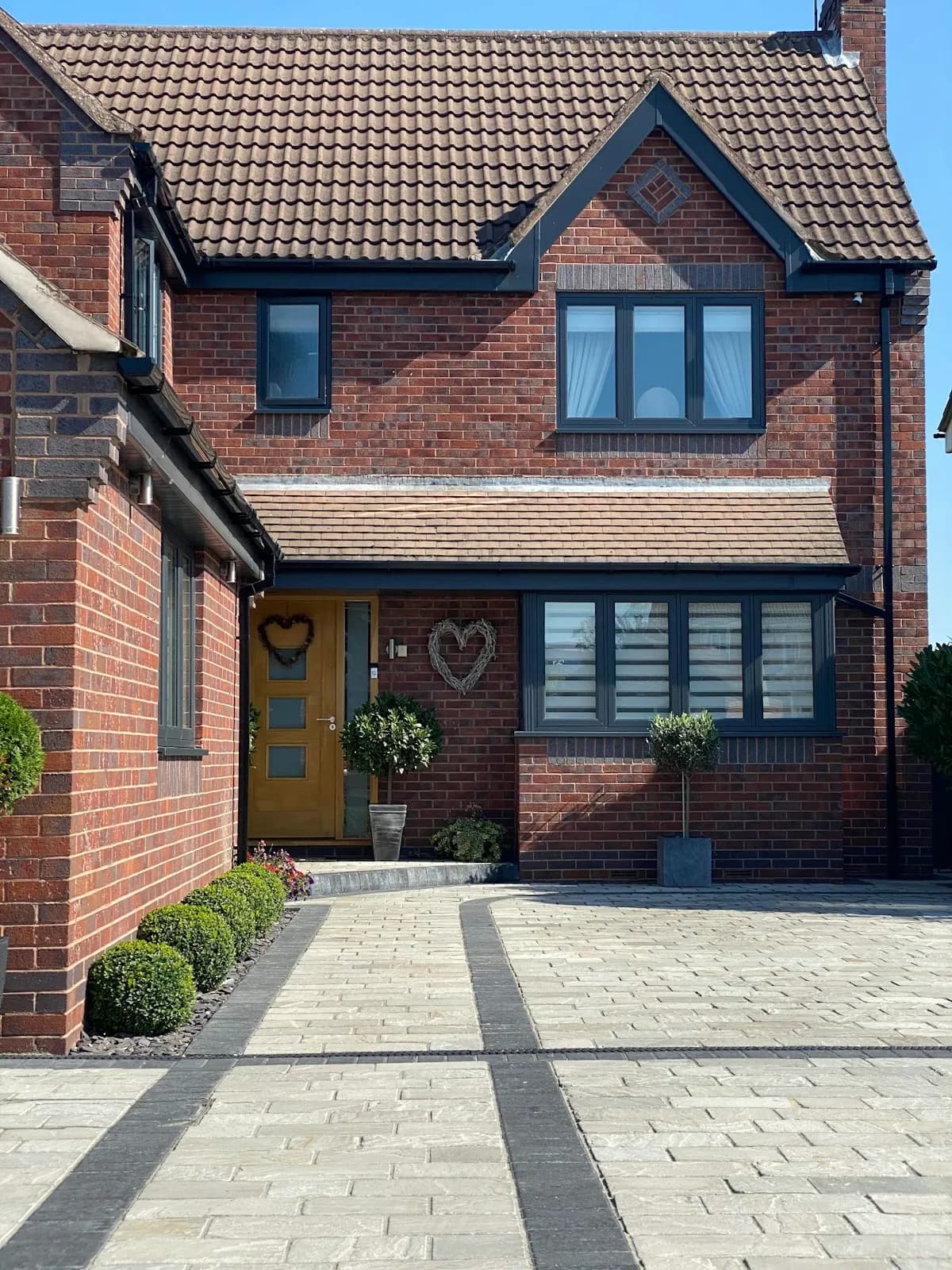
A driveway is a different structure that happens to share a surface with the patio. Pavers must be 80 mm rather than 60 mm, the base must be ten to twelve inches rather than six, and the pattern should be herringbone so wheel loads cannot rack the units. Poured concrete driveways need at least four inches of reinforced slab, often five or six where trucks turn. Asphalt is cheapest and is a separate trade entirely.
Permeable paver driveways are increasingly specified where stormwater rules bite, and HomeAdvisor's June 2026 average of $12,000 for a paver driveway spans both conventional and permeable systems. Plow damage is the main cold-climate risk for any paver driveway; a slightly chamfered unit and a plow with shoes solve most of it. The walkways and driveways page sets out the base by traffic type.
Segmental concrete block is the default for residential walls because the units interlock, set back automatically, accept geogrid and can be engineered to any residential height. Natural stone walls, dry-laid or mortared, are handsome and long-lived but need skilled labor and a wider footprint. Pressure-treated timber is cheapest and quickest for low garden walls and lasts fifteen to twenty-five years before rot at the soil line. Poured concrete walls are strong and thin but cost more and usually need veneer to look finished.
Zonda's 2025 Cost vs. Value Report records a 207.9% return on manufactured stone veneer, which is why veneer over block or poured concrete is a common upgrade. CMHA's production data shows segmental wall unit output fell -6.1% in 2023, but block remains the material most engineers and inspectors are comfortable with. The block versus timber page compares the two most common choices.
The fuel decision comes first because it determines clearances, permits and where the feature can go. Wood fire pits and fireplaces need generous clearance from structures and overhangs, produce embers and are restricted or banned in many western and urban jurisdictions on burn days or year-round. Gas features can sit closer to seating, run under a pergola in many cases if the manufacturer allows it, and are usually permitted where wood is not, but need a line, a licensed installer and a permit.
Construction follows fuel. A built-in wood pit is a masonry ring on a footing with a firebrick liner. A gas pit is a vented enclosure around a burner with a key valve and often an ignition circuit. Fireplaces are either prefabricated kits faced with veneer or custom masonry, with HomeAdvisor's June 2026 guide putting most fireplaces between $1,500 and $8,000 and a custom masonry unit far higher. Houzz finds 18% of 2026 outdoor renovators adding one. The gas versus wood page takes the fuel decision further.
In frost regions choose flexible systems: pavers or dense stone on a deep, free-draining base, and avoid porous stone and thin slabs. On expansive clay, favor pavers over concrete because they tolerate movement, add geotextile, and treat permeable systems with caution unless underdrained. In hot, sunny climates prefer light, honed surfaces such as travertine or light concrete pavers, since dark stone and stamped concrete become uncomfortable barefoot.
In storm-intense or regulated areas, permeable pavers and careful grading can be the difference between an approved plan and a rejected one. Coastal sites need salt-tolerant stone and stainless or aluminum edging. Everywhere, the base is the same story: a material can only perform as well as what it sits on. Sample boards and a test hole together tell you more than any brochure, and the planning quiz checks the key points.
Homeowner polls
The compare pages set each of these against the others.
No votes yet. Yours will be the first. · saved on this device
No votes yet. Yours will be the first. · saved on this device
No votes yet. Yours will be the first. · saved on this device
Dense natural stone such as bluestone or granite, dry-set on a proper base, lasts indefinitely and needs only occasional joint sand. Concrete pavers are close behind and are easier to repair. Poured concrete lasts decades on stable soil but cannot be spot-repaired. Every option depends on the base; a perfect stone on a thin base fails before a plain paver on a good one.
They can be, on the right base. Porcelain is dense, stain-proof, frost-proof and available in convincing stone looks, but it is thin and brittle, so it needs a very flat bedding layer or a pedestal system and an installer who has laid it before. It is not the right choice for driveways or for sites with tree roots or soil movement.
Dark charcoal and slate-toned surfaces can exceed comfortable barefoot temperature in full summer sun, particularly in the South and Southwest. Lighter concrete pavers, travertine and honed limestone stay noticeably cooler. If the patio is beside a pool or will be used barefoot, test a sample in the sun before choosing.
Yes, and mixing is common: a concrete paver field with a natural stone or clay border, or a stone patio edged in block to match a seat wall. The base does not change, but thicknesses do, so the bedding layer must be adjusted to keep the surface flush. Mixed materials add cutting labor and cost; keep transitions simple and straight.
Rarely. Stamped concrete costs close to entry-level pavers to install, needs periodic resealing to hold its color, and cracks like any slab. A cracked stamped surface is hard to patch invisibly. Pavers cost somewhat more upfront but can be spot-repaired and do not need sealing. Over ten years the totals tend to favor pavers unless the slab never moves.
At least an inch and a half for irregular flagstone, and gauged one-inch stone only if the base and bedding are flat and the pieces are large. Thin stone breaks under point loads from furniture. For steps and caps, two inches is standard. Mortared stone over a concrete slab can be thinner but then inherits the slab's cracking behavior.
No. Walls are usually built from segmental block for structural reasons and then either left as block, capped in stone, or faced with veneer to match the house or patio. Matching the cap to the patio border is enough to tie the elements together. A timber wall next to a stone patio reads as temporary and is often replaced within the wall's life.
A masonry fireplace or fire pit lined with firebrick, on a proper footing, outlasts everything else. Steel fire pits rust through in a few seasons unless they are heavy gauge or stainless. Prefabricated fireplace kits last well when faced with veneer and kept dry. Gas burners need periodic cleaning and eventual replacement regardless of the surround.
 Service guidePaver Patio Installation
Paver patio installation is the excavation, compacted stone base, bedding layer, laid pavers, edge restraint and joint fill that together create a level, drained outdoor surface.
 Service guideWalkways & Driveways
Walkway and driveway work covers paths from the street or driveway to the door, garden paths, and vehicle surfaces in pavers, permeable pavers, concrete or stone.
 Service guideRetaining Wall Construction
Retaining wall construction turns a grade change into stable, usable ground with a footing, a wall of segmental block, stone, timber or poured concrete, and the drainage stone and pipe behind it.
 Service guideFire Pit & Fireplace Install
Fire pit and fireplace installation covers built-in wood or gas fire pits, masonry or prefabricated outdoor fireplaces, the non-combustible surface around them, gas or electrical lines and the clearances local rules require.
 PlanningHow to plan a patio or hardscape project so nothing gets torn out later
Plan a hardscape project in the order it will be built: survey the site and map where water goes, decide the layout and levels, settle utilities and anything that must be buried, then choose surfaces and features.
 CostsThe 2026 hardscape cost guide: what patios, walls and drives really cost
In 2026 a professionally installed paver patio runs about $10 to $24 per square foot, a poured slab roughly 40 percent less, natural stone up to $30.
 PermitsHardscape permits and codes: what triggers review, and what happens if you skip it
No, in most U.S.
 Free toolPatio cost calculator
Size, material tier and complexity in, a realistic budget range out.
 Free toolCompare hardscape options, row by row
Side-by-side tables for the decisions that change the price most.
 Free toolHardscape planning quiz
9 questions that show what you already know and what to check next.
 Free toolHardscape polls: how other homeowners are deciding
See what other planners chose and add your vote.
Tell us the size, the condition of what is there now, and what you want to change. Patio Scopebook passes your request to independent local professionals, who reply with written, no-obligation estimates. The service is free to use.