Which fuel would you choose for a fire feature?
No votes yet. Yours will be the first. · saved on this device
Loading...
Patio Scopebook · Service guide
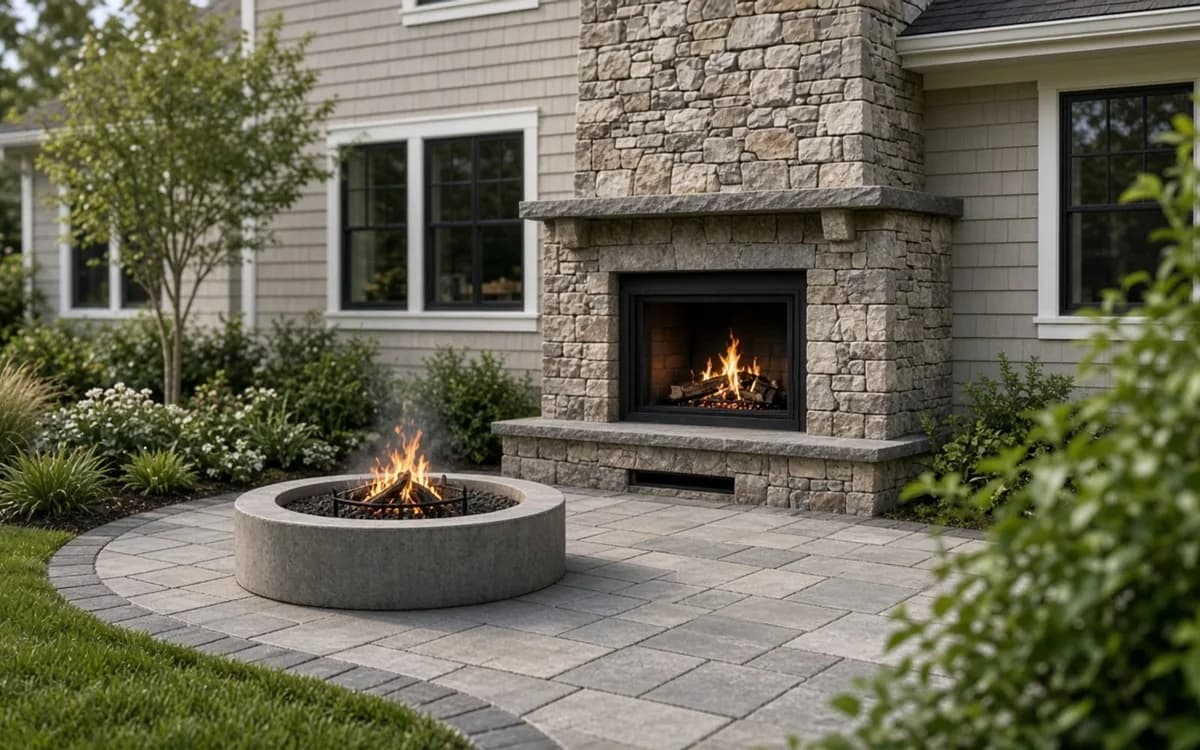
Fire pit and fireplace installation covers built-in wood or gas fire pits, masonry or prefabricated outdoor fireplaces, the non-combustible surface around them, gas or electrical lines and the clearances local rules require. It suits homeowners who use the patio on cool evenings and want a permanent gathering point rather than a portable bowl.
A fire feature is the part of a patio plan that changes how the space gets used, and the part most often bought for the wrong reason. NAR's 2023 Remodeling Impact Report found 78% of fire-feature owners did it to add features and improve livability, and the project earned a 9.7 Joy Score. The same report estimated a gas fire feature with a flagstone patio recovers about 56% of its cost at resale. Buy it for the evenings, not the appraisal.
Houzz's 2026 Outdoor Trends Study found fire features in 18% of outdoor renovations and in 48 percent of lounge areas specifically. This page covers what a fire pit or fireplace costs, gas versus wood, where it can legally go, what the gas line and surface need, and how to get it into the patio plan before the base is built so it is not a retrofit.
Want the numbers only? Read the fire pit & fireplace install cost guide for 2026 ranges, what moves the price, and sample budgets.
| Item | Low | High | Unit | Notes |
|---|---|---|---|---|
| Portable or kit fire pit on a paver pad | $250 | $2,200 | flat | Lawn Love 2025 typical range; average $830 |
| Built-in wood-burning fire pit | $1,000 | $3,000 | flat | Block or stone ring with steel or fire-brick liner |
| Built-in natural gas fire pit, unit only | $400 | $3,000 | flat | Lawn Love 2025; before the gas line |
| Natural gas line from meter | $14 | $25 | per linear ft | Trenched before the patio base; plumbing permit extra |
| Outdoor fireplace, block or prefab | $1,500 | $8,000 | flat | HomeAdvisor 2026 typical range; average $3,000 |
| Custom masonry outdoor fireplace | $8,000 | $21,000 | flat | Stone veneer, footing, chimney; can exceed $21,000 |
| Electrical circuit for ignition or lighting | $400 | $1,200 | flat | Licensed electrician; often shared with patio lighting |
Build in if you will sit outside on cool evenings through spring and fall, if you want gas for instant flame and no smoke, and if the patio is being built or rebuilt anyway so the gas line and the non-combustible surround can go in with the base. A built-in feature anchors the seating layout and, for a fireplace, gives wind protection and a focal wall. Lawn Love's 2025 guide puts a built-in fire pit at $1,000 to $3,000, which is within reach for most patio budgets. Houzz's 2026 outdoor study found 34% of renovators want better space for entertaining, and fire is what keeps guests outside after sunset.
Buy a portable pit or bowl if you use the yard mostly in summer, if local rules restrict open burning, if you are unsure where the seating will settle, or if you expect to sell within a few years. A Talker Research survey for Trex found 38 percent of homeowners want a fire pit, and many of them are best served by a $300 bowl on a paver pad. The polls show how other homeowners split on this.
Wood is cheaper to install, gives real crackle and heat, and needs no utility connection. It also produces smoke and embers, needs a place to store wood, leaves ash to clean, and is the first thing banned during air-quality alerts and burn restrictions. Many municipalities and HOAs limit wood-burning features by distance from structures or prohibit them outright in dense neighborhoods. Natural gas or propane gives instant flame, no smoke, no ash and cleaner clearances, and can be turned off with a key or a switch when the evening ends.
The cost of gas is the line, not the burner. Lawn Love reports natural gas pits at $400 to $3,000 before the gas line, which adds $14 to $25 per linear foot from the meter to the pit. A 40-foot run is $560 to $1,000 plus a plumber's permit, and it must be trenched before the patio base goes down. Propane avoids the trench but means a tank hidden in a cabinet and refills. If the meter is far from the seating area, price both fuels with the line included before deciding.
| Factor | Wood-burning | Natural gas or propane |
|---|---|---|
| Installed unit cost | Lower; masonry $2,000 to $3,200 (HomeAdvisor) | Higher; $1,800 to $3,500 plus line |
| Ongoing cost | Firewood, chimney or ring cleaning | Fuel by the hour; annual burner check |
| Smoke and embers | Yes; affects neighbors and clearances | None |
| Burn restrictions | Subject to local and seasonal bans | Usually allowed when wood is banned |
| Placement flexibility | Larger clearances required | Tighter clearances, but tied to the line |
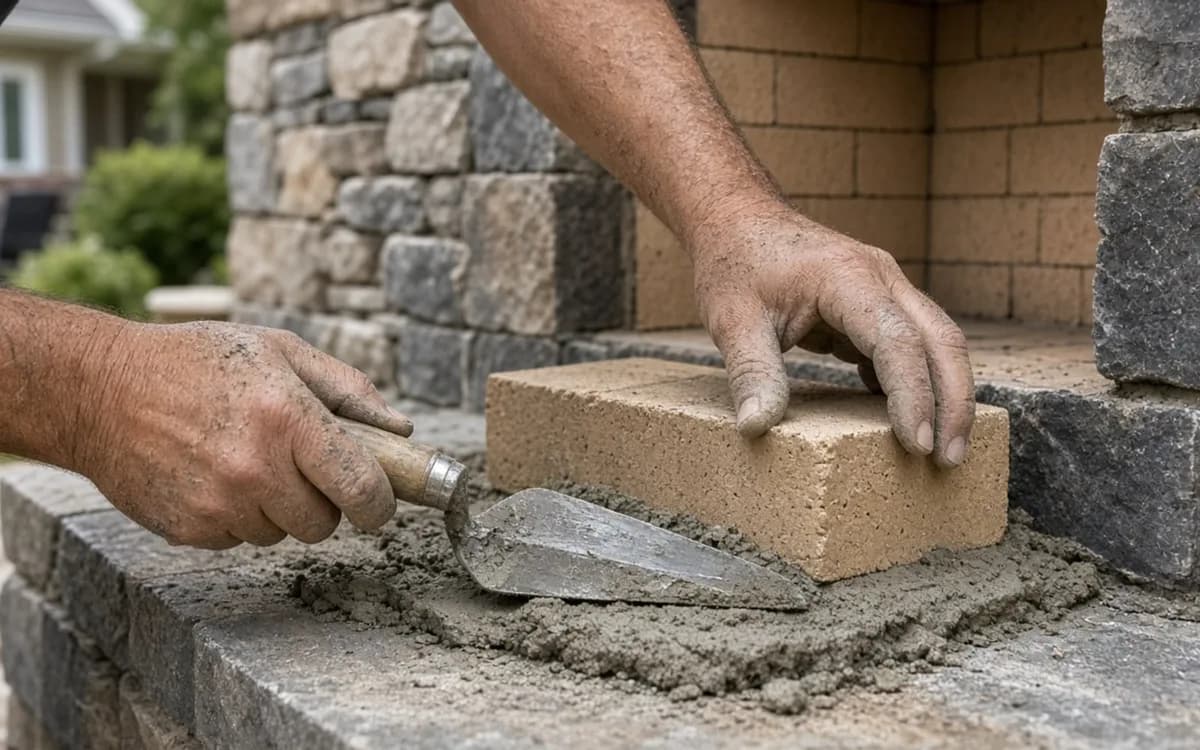
Lawn Love's December 2025 guide puts the average installed fire pit at $830, with a typical range of $250 to $2,200 and built-in models at $1,000 to $3,000. HomeAdvisor's June 2026 fireplace guide reports an average of $3,000, most projects between $1,500 and $8,000, with stone construction at $1,800 to $5,000 versus $800 to $2,000 for block, and custom masonry fireplaces passing $21,000. NAR's report priced a dry-stacked stone kit with a gas burner and a ten-foot flagstone patio at about $9,000, which is a realistic all-in number for a modest gas pit with its own surface.
The extras are where budgets slip: the gas line, a plumber's permit, an electrical circuit for an ignition or lighting, a wind guard, a cover, and the non-combustible pad or patio area around it. A fireplace adds a footing, a chimney with a spark arrestor and often a masonry veneer, which is why it starts where a pit ends. Put any lighting on a timer: our analysis of EIA's 2024 household survey found 43.4% of homes leave outdoor lights on all night. Price the feature, the fuel connection and the surrounding surface as three lines so the calculator bracket for the patio and the feature's own cost stay separate.
Local rules govern, and they vary more than for any other hardscape element. Common requirements: a wood-burning pit at least 10 to 25 feet from any structure, fence, deck or overhanging branch; gas units closer, per the manufacturer's listing; nothing under a roof or pergola unless the unit is listed for it; and a non-combustible surface of pavers, stone or concrete extending well beyond the rim. Fireplaces need chimney height above nearby rooflines and a spark arrestor. Some cities require a permit for any permanent fire feature; nearly all require a plumbing permit for the gas line.
Beyond the rules, think about wind, smoke and sightlines. Put a wood pit where prevailing wind carries smoke away from the house and the neighbor's windows; put a fireplace where its back wall blocks that wind. Keep a clear route for someone stepping back from the heat, and do not put the feature at the edge of a drop or a retaining wall. A pro who asks about setbacks and wind on the first visit is the one to hire.
The sequence matters. Gas and electrical lines are trenched and sleeved first, with the stub-out located exactly where the burner will sit. The patio base is then built over them, and the fire pit's own footing, whether a compacted pad for a kit or a concrete footing for a masonry fireplace, goes in at the same time. Seating radius comes next: a circular pit wants about six to seven feet from the center to the seat wall or chair backs so people are warm but not scorched; a fireplace wants seating facing it in a shallow arc, with the fire opening at or slightly above seated eye level.
This is why a fire feature designed after the patio is poured costs more and looks like an afterthought: the line has to be cut in, the surface patched, and the seating squeezed. Bring the feature into the whole-yard plan at the start, even if it is built in a later phase, so the sleeve, the pad and the seating space are already there. NAR's 2023 report found 78% of fire-feature owners added one to add features and improve livability; laying the gas sleeve with the patio base keeps that option cheap.

On wood pits, the liner. A dry-stacked block ring with no steel or fire-brick liner spalls from the inside after a few seasons of heat, and the caps crack. Specify a steel insert or fire brick with refractory mortar. On gas units, water: a burner pan that does not drain fills with rain, the media floats and the ignition corrodes. Specify a drained pan, a cover and lava rock or fire glass rated for the burner. On fireplaces, the firebox and the chimney cap; cheap prefabricated units without refractory panels crack, and a missing spark arrestor is a code violation and a fire hazard.
Surface damage around the feature is common when the pad is undersized or the pavers are not heat-tolerant; some sealed or resin-bound surfaces discolor. Keep a two-foot ring of plain concrete paver or stone around a wood pit and never use river rock or wet stone inside the ring, which can pop when heated. A five-minute annual check of the burner, the valve and the cap prevents most of the rest.
In the arid West and much of California, wood-burning outdoor features face seasonal bans and some municipal prohibitions, so gas is the practical default and the line cost should be budgeted from the start. In the Northeast and Midwest, the season a fire feature adds, March through May and September through November, is exactly when a patio otherwise sits empty, which is the strongest case for building one; freeze-thaw means the pad and any masonry need proper footings and drainage. In the humid Southeast, drainage of the burner pan and rust-resistant components matter most. The regional notes list the questions to ask a local pro about burn rules in your area.
The exact unit or a drawing of the masonry with dimensions; fuel type; who runs the gas line, its length, pipe size and the permit; the electrical circuit if any; the footing or pad specification; the surrounding non-combustible surface and its extent; clearances to structures and the rule they satisfy; the cover, wind guard and ignition type; and the warranty on the burner. If the same contractor is building the patio, the proposal should show the trench and stub-out on the patio plan. Send the seating idea, photos of the yard and distance to the meter through the project brief and the matched pros can confirm what your jurisdiction allows.
Homeowner polls
No votes yet. Yours will be the first. · saved on this device
Houzz's 2026 study found shade structures in 35% of outdoor projects.
No votes yet. Yours will be the first. · saved on this device
No votes yet. Yours will be the first. · saved on this device
 Service guidePaver Patio Installation
Paver patio installation is the excavation, compacted stone base, bedding layer, laid pavers, edge restraint and joint fill that together create a level, drained outdoor surface.
 Service guideOutdoor Living Spaces
Outdoor living space planning coordinates patio, seating, cooking, shade, lighting, fire, paths, walls and planting into one plan that can be built at once or in phases.
 Service guideRetaining Wall Construction
Retaining wall construction turns a grade change into stable, usable ground with a footing, a wall of segmental block, stone, timber or poured concrete, and the drainage stone and pipe behind it.
Only a gas unit specifically listed for use under a cover, and only with the clearance to the ceiling the manufacturer specifies, typically eight feet or more with ventilation on the sides. Wood-burning pits do not belong under any roof, pergola or awning; embers and radiant heat ignite them and most codes prohibit it. A fireplace with a proper chimney extending above the roofline is the way to get fire under a covered structure.
Most local codes require 10 to 25 feet between a wood-burning pit and any structure, fence or overhanging branch, and some say more. Gas units follow the manufacturer's listed clearances, which are often much smaller. Your municipality's fire prevention office is the authority; call before you buy the unit, and ask the installer to put the distance and the rule it satisfies in the proposal.
A typical 60,000 BTU natural gas burner uses roughly 0.6 therms an hour, which in most U.S. markets is under a dollar per hour at 2026 residential rates. Propane costs more per hour and a 20-pound tank lasts roughly 6 to 12 hours at medium flame. The installation is the real expense; the operating cost of a few evenings a week is minor compared with firewood bought by the bundle.
Almost always for the gas line, which a licensed plumber or gas fitter pulls, and sometimes for the feature itself if it is permanent or masonry. Electrical for ignition or lighting needs an electrical permit. Unpermitted gas work can void homeowner insurance coverage and shows up at sale. Ask the installer which permits apply and who is pulling each one, and get that in the proposal.
Either, as long as it is rated for gas burners. Lava rock is cheaper, hides the burner well and drains; fire glass is more decorative and reflects light but costs more and shows debris. Never use river rock, pea gravel or wet stone; trapped moisture turns to steam and can fracture the stone. Keep the media dry with a cover and replace it when it is crumbling or discolored.
Neither is a resale play. NAR's 2023 report estimated a $9,000 gas fire feature with a flagstone patio recovers about 56%, and larger fireplaces recover less because they cost more. A fireplace makes sense when you want a wind-blocking focal wall and year-round use; a pit is cheaper, more social and easier to place. Choose by how you will sit, not by what a buyer might think.
Yes, and pavers make it easier than a slab: the units over the trench route are lifted, the gas line is laid and sleeved, and the pavers are relaid over compacted base. A gas stub-out comes up through a cut paver at the pit location. The pit itself sits on the existing base if it is compacted well, or on its own pad. Expect the retrofit to cost 20 to 40 percent more than doing it during the original build.
Line it. A steel fire ring or a course of fire brick set in refractory mortar takes the heat so the decorative block does not. Leave a small drain gap at the bottom, keep the fire size reasonable, and let the pit cool before dousing it; a sudden cold soak on hot masonry is what cracks caps and liners. In freeze climates, keep water out over winter with a cover so ice does not spall the block.
 Free toolPatio cost calculator
Size, material tier and complexity in, a realistic budget range out.
 Free toolCompare hardscape options, row by row
Side-by-side tables for the decisions that change the price most.
 Free toolHardscape planning quiz
9 questions that show what you already know and what to check next.
 Free toolHardscape polls: how other homeowners are deciding
See what other planners chose and add your vote.
Tell us the size, the condition of what is there now, and what you want to change. Patio Scopebook passes your request to independent local professionals, who reply with written, no-obligation estimates. The service is free to use.