Which best describes your project?
No votes yet. Yours will be the first. · saved on this device
Loading...
Patio Scopebook · Services
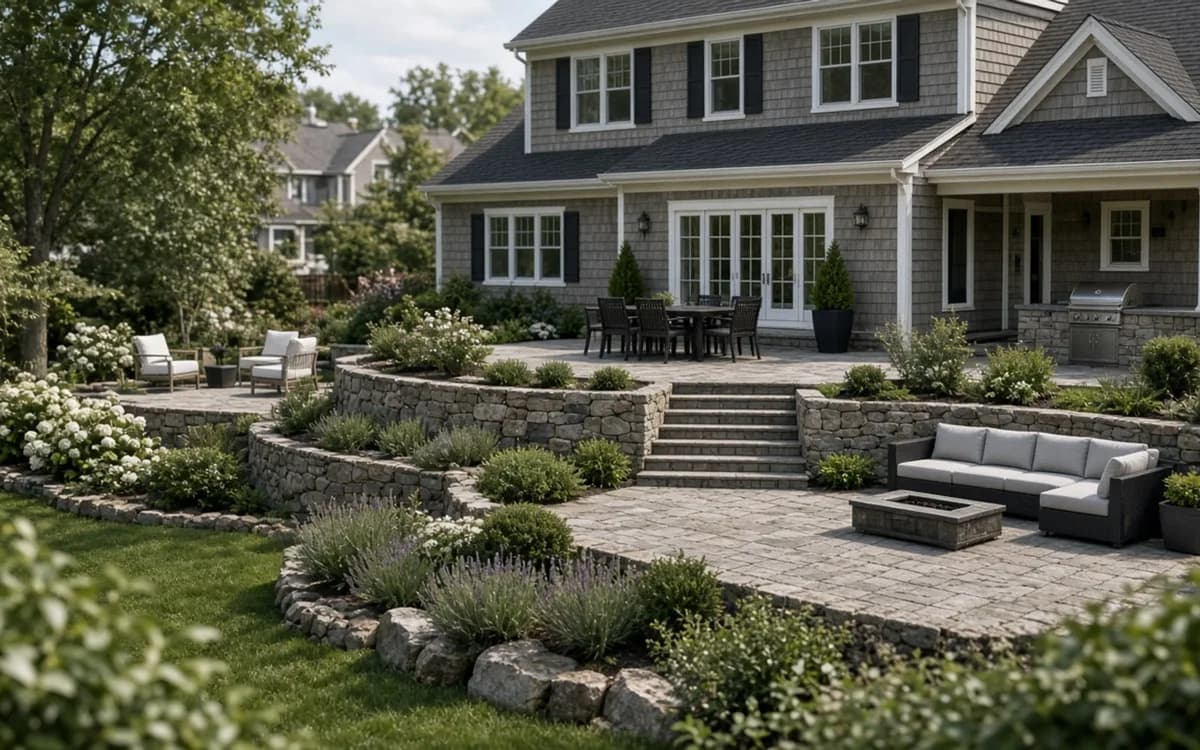
This overview separates five kinds of hardscape work by what the ground has to do: carry people, carry vehicles, hold back soil, host fire or tie a whole yard together. Each page explains who the service suits, what it costs, what fails first and what a proposal should specify. Matched local pros provide a free written estimate for the scope you choose.
Homeowners usually arrive with a material in mind. Estimators think in scopes, because a paver patio, a paver driveway and a paver walkway are three different base designs, three different thicknesses and three different prices even when the paver on top is identical. Sorting your project into the right scope first is the quickest way to get proposals you can compare.
Below is how the five services on this site divide the work, who each is for and when to skip it. Houzz's 2026 Outdoor Trends Study found 71% of outdoor renovators hired a professional, and 20% hired a stone, paver or concrete specialist specifically. The pages here are written so you can brief that specialist well.
 Service guidePaver Patio Installation
Paver patio installation is the excavation, compacted stone base, bedding layer, laid pavers, edge restraint and joint fill that together create a level, drained outdoor surface.
 Service guideRetaining Wall Construction
Retaining wall construction turns a grade change into stable, usable ground with a footing, a wall of segmental block, stone, timber or poured concrete, and the drainage stone and pipe behind it.
 Service guideFire Pit & Fireplace Install
Fire pit and fireplace installation covers built-in wood or gas fire pits, masonry or prefabricated outdoor fireplaces, the non-combustible surface around them, gas or electrical lines and the clearances local rules require.
 Service guideWalkways & Driveways
Walkway and driveway work covers paths from the street or driveway to the door, garden paths, and vehicle surfaces in pavers, permeable pavers, concrete or stone.
 Service guideOutdoor Living Spaces
Outdoor living space planning coordinates patio, seating, cooking, shade, lighting, fire, paths, walls and planting into one plan that can be built at once or in phases.
| Service | Best for | Skip it if |
|---|---|---|
| Paver Patio Installation | A level or gently sloped outdoor room for dining and seating where you want a pattern, a border and the ability to lift and reset units later. | You need the lowest possible price for a short-term hold, or the area is a vehicle route; poured concrete or a driveway scope fits better. |
| Retaining Wall Construction | A yard with a grade change you want to turn into usable terraces, or a slope that is eroding toward a patio, driveway or foundation. | The grade change is under a foot and can be handled with a planted slope or a single step; a wall adds cost and drainage detail you may not need. |
| Fire Pit & Fireplace Install | Homeowners who will use the patio on cool evenings and want a permanent gathering point with gas or wood heat and proper clearances. | You are buying it for resale; NAR data shows fire features recover about half their cost, so a portable pit may be the wiser spend. |
| Walkways & Driveways | A front entry that needs curb appeal, a path that has to stay dry and level, or a driveway you want to replace with pavers or permeable surface. | The existing concrete is sound and only stained; cleaning and sealing or a thin overlay costs a fraction of replacement. |
| Outdoor Living Spaces | A yard being planned in phases, with a kitchen, shade structure, lighting or pool coming later and utilities to route now. | You have one patio and no future phases; a straightforward patio scope with a drainage plan covers it. |
By the numbers
71%
of surveyed outdoor renovators hired a professional (Houzz 2026 Outdoor Trends Study)
Among renovators surveyed for the 2026 study, 26% hired a landscape contractor and 20% a stone, paver or concrete specialist. Planned and completed projects are mixed and the sample is Houzz users, not a national count.
2026 U.S. Houzz Outdoor Trends Study (2026)20%
of surveyed outdoor renovators hired a stone, paver or concrete specialist (Houzz 2026)
One in five outdoor renovators in Houzz's 2026 study hired a hardscape specialist specifically, the trade most likely to price base and drainage correctly. The figure describes surveyed Houzz users with recent, current or planned projects.
2026 U.S. Houzz Outdoor Trends Study (2026)$2,029 to $6,088
typical patio installation cost per project (Angi, updated May 2026)
Angi's U.S. planning reference for a patio project. Retaining walls, fire features, major drainage changes and driveways need their own scope and price on top of this range.
Angi, How Much Does It Cost to Install a Patio? (2026)$6,084
average retaining wall, or $40 to $360 per linear ft by height (HomeAdvisor, June 2026)
A 2-foot wall runs $40 to $200 per linear foot while a 6-foot wall can reach $360. Most homeowners spend $3,192 to $9,206. By material per square foot: timber $15 to $30, concrete $30 to $50, gabion or stone $10 to $100, steel $15 to $150.
HomeAdvisor, Retaining Wall Cost Guide (2026)A paver patio carries foot traffic and furniture, so six to eight inches of compacted base under an inch of bedding is the common target. A driveway carries two-ton vehicles that turn and brake, so the base grows to ten to twelve inches (one reason HomeAdvisor's average paver driveway is $12,000), the paver is often thicker, and the edge restraint has to resist lateral push. A retaining wall does not carry load from above so much as resist it from behind: the footing, the drainage stone and the perforated pipe behind the block do the real work.
A fire feature adds heat, fuel and clearance to the plan; the surrounding surface has to be non-combustible and the gas or electrical route has to be trenched before the base goes down. An outdoor living plan is the coordination layer: it decides where all of the above go, in what order, and which utilities are sleeved now so later phases do not mean lifting finished work.
These are national references from published cost guides. Regional labor rates, soil, access and design detail move every one of them far more than the material does: Freedonia sizes U.S. demand for hardscaping products at $4.4 billion in 2024, and CMHA reported paver production down -9.9% in 2023, so block and paver supply is rarely the constraint. The calculator adjusts for size, tier and complexity; a matched pro's site visit replaces all of it with a real number.
| Scope | Typical published range | Reference |
|---|---|---|
| Paver patio | $8 to $24 per sq ft installed; 280 sq ft averages $3,350 | Lawn Love 2025 |
| Patio installation, overall | $2,029 to $6,088 per project | Angi 2026 |
| Retaining wall | $40 to $360 per linear ft by height; $6,084 average | HomeAdvisor 2026 |
| Fire pit | $830 average; built-in $1,000 to $3,000 | Lawn Love 2025 |
| Outdoor fireplace | $3,000 average; $1,500 to $8,000 typical | HomeAdvisor 2026 |
| Paver walkway | $13 to $27 per sq ft | Lawn Love 2025 |
| Paver driveway | $12,000 average; $6,000 to $18,000 typical | HomeAdvisor 2026 |

Combine anything that shares excavation. If a seat wall, a step and a patio all sit on the same base, one mobilization and one haul-away beats three. HomeAdvisor's average interlocking paver job runs $3,400, and hardscape is one of the trades where bundling genuinely reduces cost because the equipment is the expensive part.
Keep separate anything that needs its own trade or its own approval. A gas line for a fire feature is a plumber's scope; an engineered wall is a structural engineer's scope before it is a mason's; a driveway apron at the street may involve the public works department. Asking for those as separate priced lines inside one proposal keeps the total honest without splitting the job across contractors who will not coordinate.
Houzz's 2026 study found 41% of outdoor projects start because the existing space has worn out, so show the failure. Send the square footage you think you want, photos of the area after a heavy rain, the doors and gates the space has to connect to, and the widest access point for equipment. Say what the space is for: dining for six, a fire pit for evenings, a path that has to take a wheelbarrow. Mention slopes, settled areas, buried lines you know about and any tree whose roots you want to protect. The contact page lists what to include; a good brief produces estimates that match each other.
Homeowner polls
No votes yet. Yours will be the first. · saved on this device
The compare pages set each of these against the others.
No votes yet. Yours will be the first. · saved on this device
Anything that changes grade or needs trenching: retaining walls, drainage, gas and electrical sleeves, then the main patio. Surfaces go in after the vertical and underground work so finished areas are never dug up. Lighting fixtures, planting and furniture come last. Ask the pro who builds phase one to leave sleeves and stub-outs for later phases; a few lengths of conduit now save cutting a finished patio in two years.
Often yes for the masonry, with subcontractors for the gas line and any electrical work. What matters is that one party owns the coordination and the drainage plan. Ask who pulls permits, who runs the gas line and whether the wall needs an engineer. If the answer to any of those is vague, price that piece separately with a specialist and have the general hardscape contractor confirm they will build around it.
If the yard has multiple levels, drainage problems, a pool or kitchen coming later, or the project is above roughly $30,000, a designer's plan usually pays for itself by preventing rework. For a rectangular patio on a flat lot, a good installer's layout is enough. Design-build hardscape firms bundle the drawing into the proposal; ask whether the plan is yours to keep if you do not proceed.
As a rule the material costs more, and the labor often does too because stone is irregular and heavier. LawnStarter puts installed natural stone at $12 to $30 per square foot versus $8 to $16 for concrete pavers. Regional stone, such as bluestone in the Northeast or flagstone in the Southwest, narrows the gap because freight is a large part of stone pricing. Thick-cut stone on a dry base costs less than thin stone mortared to a slab.
Most hardscape contractors set a minimum around a few thousand dollars because mobilization, equipment and disposal cost the same for 100 square feet as for 300. A small front walkway, a set of steps or a fire pit pad is typically at or just above that floor. If your project is small, bundling it with edging, a drainage fix or sealing an existing surface can make it worthwhile for both sides.
Both, and that is why they are growing while other paver categories shrink. They look like conventional pavers with slightly wider joints filled with small stone, and they drain through into a deep open-graded base. They suit yards with standing water, lots near impervious-cover limits, and driveways where runoff to the street is regulated. They are not the right answer over heavy clay with no outlet, where the reservoir simply fills and stays full.
Substantially. A yard a mini excavator and skid steer can reach through a gate of at least four feet is priced on machine hours. A yard reached only through the house or a 30-inch gate is priced on labor hours, wheelbarrow by wheelbarrow, and disposal becomes slower too. Mention the gate width and any steps in your brief; a pro who knows access is tight will price it correctly rather than adding a surprise later.
 Free toolPatio cost calculator
Size, material tier and complexity in, a realistic budget range out.
 Free toolCompare hardscape options, row by row
Side-by-side tables for the decisions that change the price most.
 Free toolHardscape planning quiz
9 questions that show what you already know and what to check next.
 Free toolHardscape polls: how other homeowners are deciding
See what other planners chose and add your vote.
Tell us the size, the condition of what is there now, and what you want to change. Patio Scopebook passes your request to independent local professionals, who reply with written, no-obligation estimates. The service is free to use.