Which surface are you leaning toward for your patio?
The compare pages set each of these against the others.
No votes yet. Yours will be the first. · saved on this device
Loading...

Patio Scopebook · Concrete pavers vs Poured concrete
Poured concrete is the cheaper patio at about 60 percent of a paver price and installs in days, but it cracks where the ground moves and cannot be spot-repaired. Concrete pavers cost more upfront, flex with frost and clay, and can be lifted and relaid. Choose concrete on stable soil for a short stay; choose pavers on active soil or for a long one.
Photo: Tile Merchant Ireland · License.
This is the comparison most homeowners start with, and the one where the cheap answer is right more often than paver advocates admit. On a flat lot with well-drained soil, in a mild climate, owned for five years, a broom-finished slab does the job at the lowest price. Everywhere else, the question is how much the ground will move and who will pay to fix the surface when it does.
The table and verdict above set out the trade-off. This page adds the scenarios where each wins, a ten-year cost view, climate and resale notes, the mistakes seen most often, and how to compare a slab bid with a paver bid line by line. Figures come from Fixr, Lawn Love, Belgard, Angi and the NAR 2023 Remodeling Impact Report, each named where used, and the calculator applies the same 60 percent ratio.
Pavers cost roughly 50 percent more than a poured slab for the same footprint but can be lifted and relaid when they settle, while concrete is cheaper, faster and will crack somewhere. The choice turns on how long you will stay and how your soil moves.
| Factor | Concrete pavers | Poured concrete |
|---|---|---|
| Upfront cost | $1,310 to $1,770 for 120 sq ft (Fixr); $8 to $24 per sq ft installed (Lawn Love) | $865 to $1,085 for 120 sq ft (Fixr); roughly $6 to $12 per sq ft |
| Lifespan | 30 to 50 years; individual units replaceable | 20 to 30 years; cracking expected, repairs visible |
| Maintenance | Joint sand top-up, optional sealing every 3 to 5 years | Optional sealing; crack filling; no joint upkeep |
| Appearance | Patterns, borders, many colors and textures | Broom, exposed aggregate or stamped; uniform |
| Climate fit | Flexes with freeze-thaw; drains at joints | Cracks with frost heave and clay movement; needs control joints |
| Install time | 4 to 10 days (HomeAdvisor) | 2 to 4 days plus 7 to 28 days cure |
| Compressive strength | 8,000 PSI or more (Belgard, manufacturer, 2020) | 3,000 to 4,000 PSI for stamped concrete (Belgard) |
| Manufacturer warranty | Transferable lifetime product warranties from major paver makers such as Belgard | No comparable product warranty; cracking is expected (Belgard) |
| Resale | About 95% recovery for a modest patio (NAR 2023) | Comparable when well finished; cracks hurt |
| Best for | Long holds, freeze-thaw climates, future utility access | Tight budgets, short holds, stable soils, large plain areas |
Pavers win for anyone staying more than five years in a climate with real winters or moving soil. The premium buys repairability: a settled corner near a downspout is lifted and relaid in an afternoon with the same units, and a gas line or irrigation repair later does not mean a saw cut and a patch. NAR's 2023 report priced a modest dry-set paver patio at about $10,500 with roughly 95 percent recovered at resale, which makes the premium close to free over a long hold.
Concrete wins when the budget is fixed and the hold is short, when the soil is stable and well drained, and for large plain areas where pattern adds nothing. A well-finished slab with control joints cut every eight to twelve feet, on a compacted base with the same slope and drainage a paver patio would get, is a legitimate patio. The mistake is buying a thin slab on unprepared soil because it was cheap; that is the concrete that cracks in year two and drags the replacement cost into the comparison.
Concrete wins where the ground is stable and the budget is tight. Sandy or gravelly subgrade that drains freely, a frost line that is shallow or absent, no large trees within root reach and a rectangular footprint all favor a slab. So does a short ownership horizon: a homeowner planning to sell within five years rarely sees the repair costs that make pavers pay. Fixr's 120 square foot comparison, $1,310 to $1,770 vs $865 to $1,085, shows the upfront saving at roughly a third.
Concrete also wins for very large plain areas, for surfaces that will carry heavy rolling loads such as a basketball half-court, and as the base for mortared stone or tile. A slab that is thick enough, reinforced and cut with control joints on a compacted base can last decades. The paver patio page explains what pavers add on top of that; on these sites they add less.
Pavers win wherever the ground moves. Clay that swells and shrinks, deep frost, tree roots and fill soil all crack slabs and merely ripple paver surfaces, which are then lifted and relaid. They win on sloped or terraced lots where the patio meets steps and walls, because units cut around curves and levels more cleanly than forms. They win where utilities will cross the patio later, since a strip can be lifted and replaced invisibly.
They also win on ownership horizon. A homeowner planning to stay ten or more years will almost certainly repair the surface once, and a paver repair is a few hours with matching units while a slab repair is a visible patch or a replacement. Lawn Love's December 2025 installed range of $8 to $24 per sq ft is the price of that repairability, and Angi's benchmark of $2,029 to $6,088 shows most projects are not large.

Take a 400 square foot patio in a mid-cost market. The slab prices around $4,000 at $10 per square foot; the paver patio around $6,800 at $17. Over ten years the slab may need a crack sealed and, on active soil, a section mud-jacked or replaced; budget $500 to $2,500. The pavers may need joint sand topped up twice and a settled corner relaid; budget $300 to $900, plus optional sealing which HomeGuide prices at $1.50 to $3.25 per sq ft.
On stable soil the slab stays ahead over ten years by roughly $2,000. On active soil, where the slab is replaced rather than patched, the totals converge or reverse. That is the honest answer: the ten-year cost depends on the subgrade, which a test hole reveals and a brochure does not. The cost guide gives the regional adjustments that move both figures together.
| Item | Poured slab | Concrete pavers |
|---|---|---|
| Install, 400 sq ft mid-market | $4,000 | $6,800 |
| Ten-year maintenance, stable soil | $300 – $800 | $300 – $600 |
| Ten-year repair, active soil | $1,500 – $4,000+ | $400 – $900 |
| Spot repair possible | No | Yes |
| Ten-year total, stable soil | ≈ $4,500 | ≈ $7,200 |
| Ten-year total, active soil | ≈ $6,500 – $8,000 | ≈ $7,400 |
In frost regions the ground heaves and settles every winter. A slab on a thin base cracks at the first hard freeze that follows a wet autumn; pavers on a free-draining base rise and fall as a sheet and settle back. Deeper bases help both surfaces, but pavers are more forgiving of the base being imperfect. In expansive clay the same applies in slower motion: the slab cracks over years, the pavers undulate and are relaid.
In hot, dry climates with stable soil the slab's disadvantages shrink and its cost advantage stands. Heat does matter for comfort: a plain gray slab and a light concrete paver are similar, while stamped, colored concrete and dark pavers both get hot underfoot. Where stormwater rules cap impervious cover, neither wins; the permeable comparison is the relevant one.
The NAR 2023 Remodeling Impact Report estimated 95% of a modest paver patio's cost recovered at resale, and homeowners gave a new patio a Joy Score of 9.9 / 10. The report did not separately score a poured slab, so the comparison has to be made on what buyers see: a level, uncracked surface. A well-kept slab and a well-kept paver patio both present well; a cracked slab presents badly and cannot be hidden.
Pavers carry a perception premium in most markets, and a patio with a border and a seat wall reads as a finished outdoor room. That premium is real but modest, and it does not justify pavers on its own. The stronger resale argument is that a paver patio is far more likely to be uncracked on the day of the listing photographs.
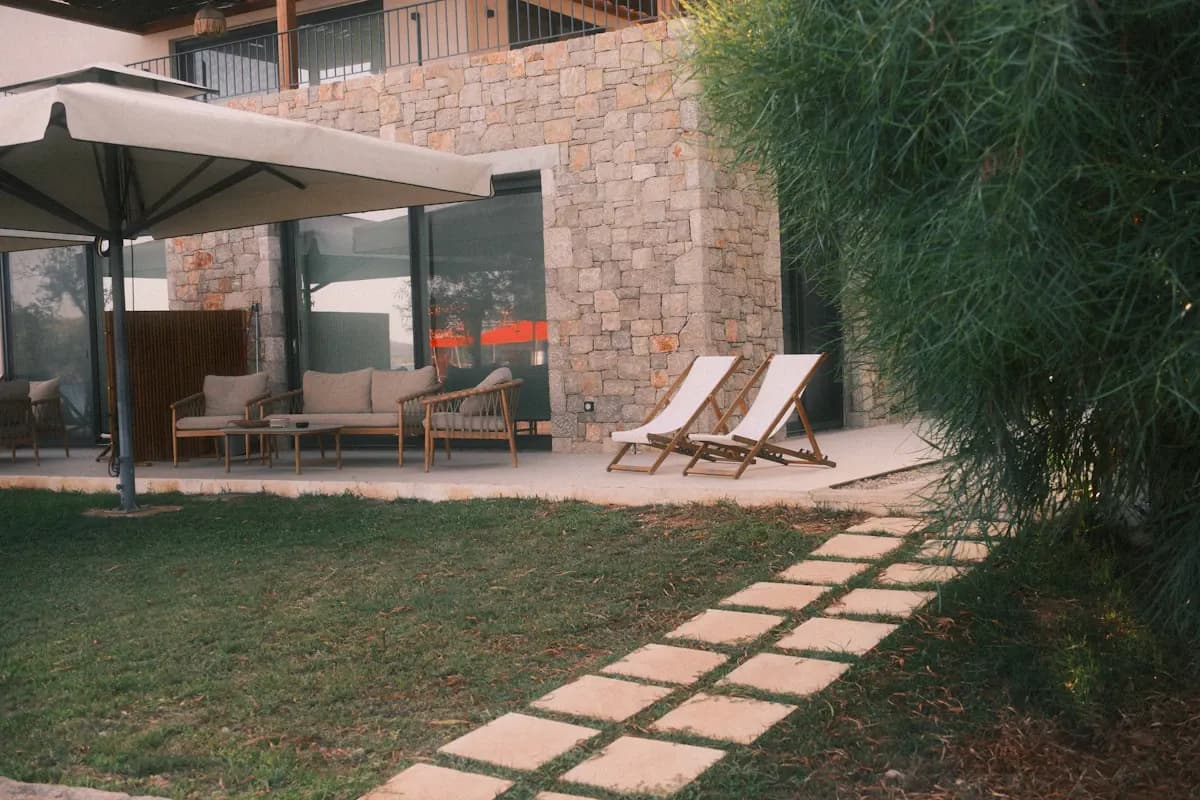
For slabs: pouring on uncompacted fill, skipping or under-cutting control joints, pouring too thin, pouring in freezing weather or extreme heat without curing measures, and finishing water into the surface so it scales later. For pavers: a base that is too thin or placed in one thick lift, bedding sand used to fill low spots, missing edge restraint, regular sand where polymeric was specified, and no fall away from the house.
Both share the biggest mistake: grading toward the house. Both also suffer when a downspout discharges onto the surface. The planning quiz covers these; a proposal that mentions compaction in lifts and a specific fall in inches per foot has usually thought about them.
Bring both to the same specification before comparing price. For the slab: thickness in inches, reinforcement type, base depth, control joint spacing, finish, and how the edge at the lawn is formed. For the pavers: base depth, bedding, paver thickness and product, pattern, border, edge restraint, joint sand and sealing if included. Both: excavation depth, disposal, fall and drainage, and access method. A slab bid without a base line is as incomplete as a paver bid without edge restraint.
Then ask each professional the same question: what will you do when this surface settles? The slab answer is mud-jacking or replacement; the paver answer is lifting and relaying. Whichever you choose, the estimate request format asks for these lines so that proposals arrive comparable.
Homeowner polls
The compare pages set each of these against the others.
No votes yet. Yours will be the first. · saved on this device
Drainage is priced before the surface on every well-written proposal.
No votes yet. Yours will be the first. · saved on this device
If the slab is sound, drains correctly and sits low enough that adding an inch of thin overlay pavers plus bedding does not raise the surface above the door threshold, yes. Thin pavers set on a sand or mortar bed over concrete avoid demolition. If the slab is cracked and moving or holds water, the pavers will follow it; remove the slab and build a proper base.
In appearance, yes; in behavior, it is concrete. Stamped and colored slabs cost more than plain concrete, often approaching paver prices, still crack along and across the pattern, and are harder to patch invisibly because the color and stamp must be matched. Belgard, a paver manufacturer, puts stamped concrete at 3,000 to 4,000 PSI against 8,000 PSI or more for pavers. Stamped slabs suit stable soils and warm climates where the look is the goal.
Typically 30 to 40 percent for the same footprint. Fixr's 120 square foot comparison puts pavers at $1,310 to $1,770 against $865 to $1,085 for concrete, and the site's calculator prices concrete at 60 percent of pavers. Decorative finishes narrow the gap; stamped and colored concrete can cost as much as entry-level pavers, and Belgard, a paver maker, calls the two comparable in price in most cases.
It will crack somewhere; the question is whether at the control joints, where it is invisible, or across the field. Proper base compaction, adequate thickness, reinforcement and joints cut at the right spacing keep cracks where they belong on stable soil. On clay, frost or tree roots, field cracks are likely within a decade.
Small, simple patios can be, but the labor is in the base, and an under-compacted base fails regardless of how well the pavers are laid. Renting a plate compactor and placing stone in lifts is the part homeowners skip. HomeAdvisor's four to ten day professional timeline gives a sense of the work involved even for crews.
Either can work; the details differ. Concrete around pools is usually broom-finished or textured for slip resistance and needs expansion joints at the coping. Pavers stay cooler in light colors, drain between joints and can be lifted to reach plumbing. Salt from saltwater pools attacks some concrete surfaces, so sealing matters for both.
It needs a compacted base, usually four inches on stable soil and more on clay or frost-prone ground, but pavers typically get six inches or more because the surface relies entirely on the base for support. Skipping the base under a slab is a common way to save money that costs more later.
Concrete. A 400 square foot slab can be formed, poured and finished in two to three days plus curing time before use. The same area in pavers takes HomeAdvisor's four to ten day range, mostly in excavation, base and cutting. Weather delays affect concrete more, since it cannot be poured in freezing or very hot conditions.
 ComparisonConcrete pavers vs Natural stone
Concrete pavers cost less, come in consistent sizes and can be replaced from stock; natural stone costs more, varies in every piece and never fades or wears out when laid at the right thickness.
 ComparisonPermeable interlocking pavers vs Conventional pavers
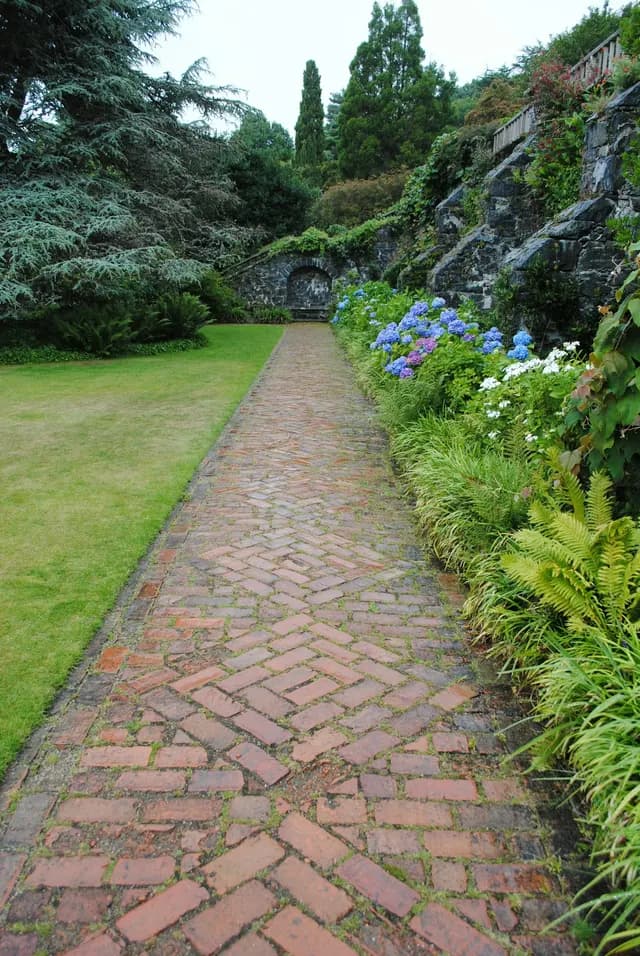
Permeable pavers pass rain through stone-filled joints into a deep open-graded reservoir, replacing the drain a conventional patio needs and often satisfying stormwater rules.
 ComparisonSegmental concrete block wall vs Pressure-treated timber wall
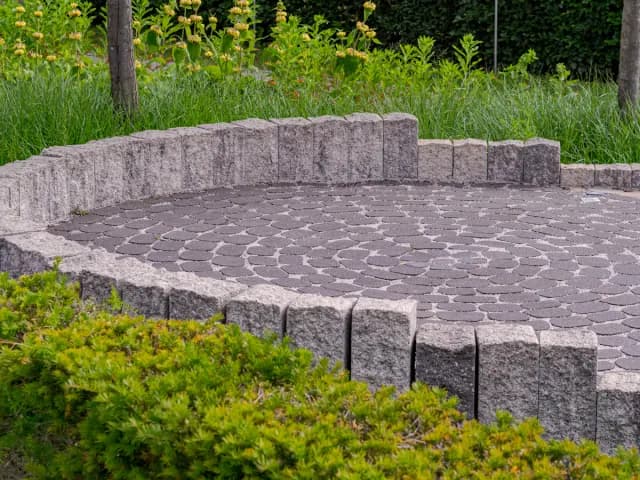
A pressure-treated timber wall is the least expensive way to hold a low slope and can be built in a day, but it rots at the soil line in fifteen to twenty-five years.
 ComparisonNatural gas or propane fire feature vs Wood-burning fire feature
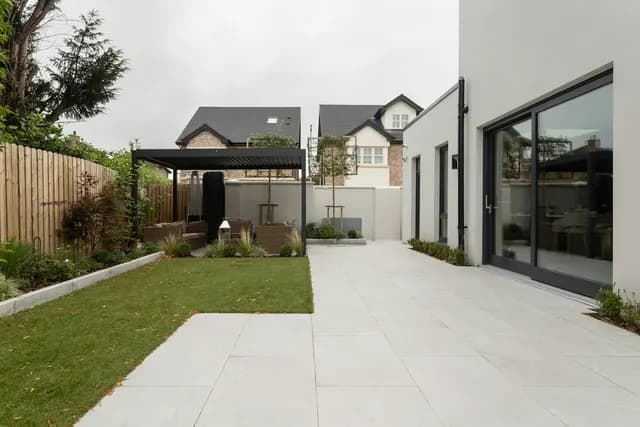
A gas fire feature lights instantly, makes no smoke or ash, is allowed where wood is banned and can sit closer to seating, but costs more to install because of the line and permit.
 Service guidePaver Patio Installation
Paver patio installation is the excavation, compacted stone base, bedding layer, laid pavers, edge restraint and joint fill that together create a level, drained outdoor surface.
 Service guideRetaining Wall Construction
Retaining wall construction turns a grade change into stable, usable ground with a footing, a wall of segmental block, stone, timber or poured concrete, and the drainage stone and pipe behind it.
 Service guideFire Pit & Fireplace Install
Fire pit and fireplace installation covers built-in wood or gas fire pits, masonry or prefabricated outdoor fireplaces, the non-combustible surface around them, gas or electrical lines and the clearances local rules require.
 Service guideWalkways & Driveways
Walkway and driveway work covers paths from the street or driveway to the door, garden paths, and vehicle surfaces in pavers, permeable pavers, concrete or stone.
 Service guideOutdoor Living Spaces
Outdoor living space planning coordinates patio, seating, cooking, shade, lighting, fire, paths, walls and planting into one plan that can be built at once or in phases.
 Free toolPatio cost calculator
Size, material tier and complexity in, a realistic budget range out.
 Free toolHardscape planning quiz
9 questions that show what you already know and what to check next.
 Free toolHardscape polls: how other homeowners are deciding
See what other planners chose and add your vote.
Tell us the size, the condition of what is there now, and what you want to change. Patio Scopebook passes your request to independent local professionals, who reply with written, no-obligation estimates. The service is free to use.