Northeast
Frost depth of 3 to 4 feet: free-draining bases, freeze-thaw rated pavers, frost-protected wall footings, no rock salt the first winter. Bluestone is the local stone. Impervious-cover limits make permeable pavers worth pricing.
Loading...
Patio Scopebook · Locations
The right patio base, wall drainage and fire-feature fuel depend on where the house sits. This page summarizes how frost depth, expansive clay, storm intensity, burn restrictions and stormwater rules change hardscape design across the Northeast, South, Midwest and West, and what to ask a local professional about your area before you compare proposals.
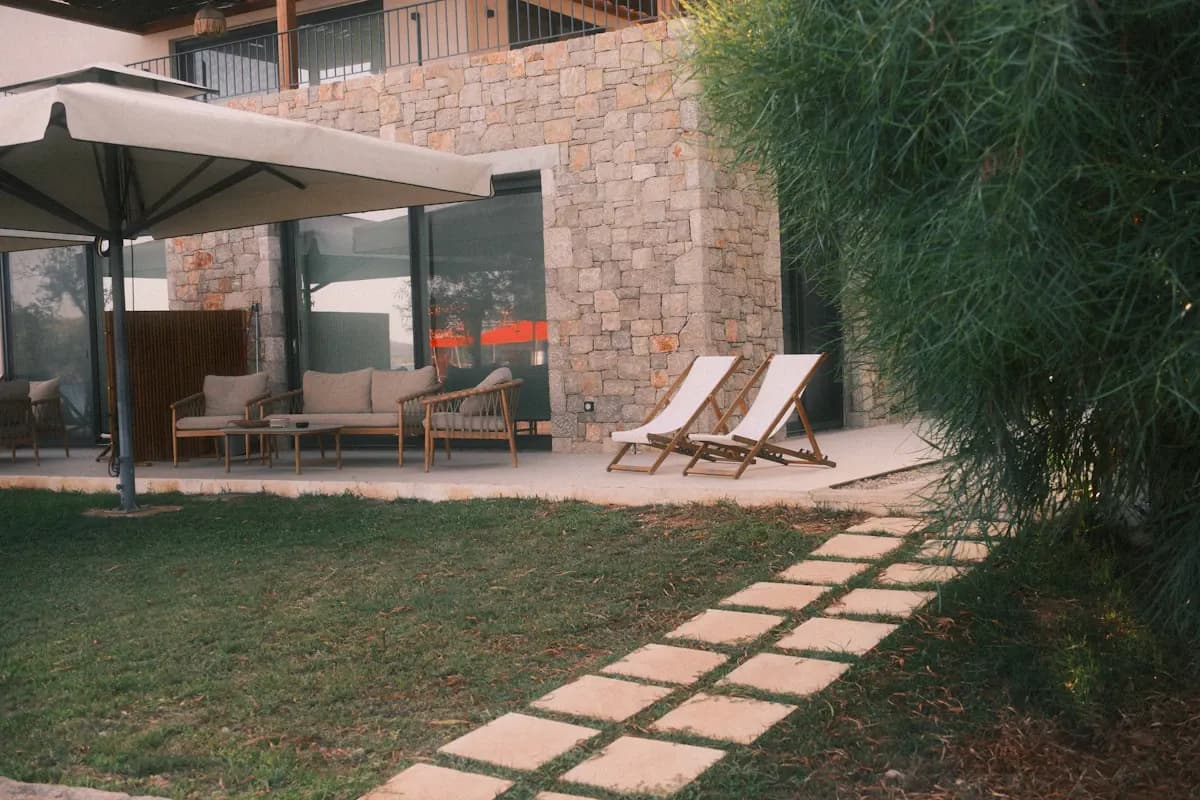
Photo: Arlind Photography · License.
A paver patio in Minneapolis and one in Phoenix use the same pavers and almost nothing else in common. One is designed around frost heave and de-icing salt; the other around expansive clay, sun fade and irrigation overspray. Retaining walls, driveways and fire features vary just as much, and local codes add their own layer: the height at which a wall needs a permit, whether wood fires are allowed, whether a permeable driveway earns a stormwater credit. Even lighting habits differ: by our analysis of the same EIA survey, 43.4% of homes leave outdoor lights on all night, 48.5 percent in the West against 33.4 percent in the Northeast.
The notes below cover each region; a local professional adds the soil, the inspector and the supply yard. Shade is a good example of how much region matters. Our analysis of the EIA's 2024 household survey found 55.6% of U.S. homes have no large shade trees, 61.0 percent in the Northeast and 59.8 percent in the West. The 44.4% that do are concentrated in the Midwest (48.7 percent) and South (46.9 percent), so a built shade structure is a first-phase item in some regions and optional in others.
Frost depth of 3 to 4 feet: free-draining bases, freeze-thaw rated pavers, frost-protected wall footings, no rock salt the first winter. Bluestone is the local stone. Impervious-cover limits make permeable pavers worth pricing.
Storm intensity, not frost, sets the design: steeper slopes, catch basins, downspout extensions. Light-colored pavers and travertine for heat; stainless hardware and drained burner pans for humidity. Expansive clay in Texas needs geotextile and wider wall drainage.
Deep frost plus heavy clay: 8 to 12 inch bases over geotextile, full drainage columns behind walls, rated pavers, flush driveway edges for plows. A fire feature adds two months at each end of a short season.
Northwest: drainage volume, moss, covered structures. Southwest: expansive clay, sun fade, irrigation overspray. California: seasonal wood-burning bans make gas the default; defensible-space rules favor non-combustible surfaces near the house.
Frost depth of three to four feet drives everything. Patio bases must be free-draining so trapped water cannot freeze and lift the surface; eight inches of open-graded stone is common and geotextile is standard on the region's silty soils. Retaining walls need frost-protected footings for any height that matters and drainage that outlets below the frost zone or to daylight. Pavers should be freeze-thaw rated, and rock salt should stay off new surfaces the first winter. Bluestone is the regional stone and, bought locally, narrows the price gap with concrete pavers. Wood-burning fire features are broadly allowed outside dense cities but check township rules. Many municipalities regulate impervious cover, which makes permeable pavers a way to add a patio without a stormwater variance.
Frost is minor or absent in most of the region, so bases can be thinner on well-drained soils, but storm intensity is the design load: a patio has to shed two inches of rain in an hour without sending it into the house. Slope, catch basins and downspout extensions matter more than in any other region, and permeable systems have to be sized for volume. Heat pushes material choice toward light-colored concrete pavers and travertine, which stay comfortable underfoot. Humidity means burner pans on gas features must drain and hardware should be stainless. Expansive clay in Texas and parts of the Southeast calls for geotextile, thicker bases and wider drainage columns behind walls. Fire features get year-round use; the season argues for building them in.

The Midwest combines deep frost with heavy clay, which is the hardest pairing for hardscape. Patio bases run eight to twelve inches of compacted, free-draining stone over geotextile, and walls need the full drainage column, filter fabric and pipe outletting to a low point that actually drains in spring. Freeze-thaw cycling, not just cold, is what spalls cheap pavers and cracks caps, so specify rated products and avoid salt. The season is short, which is the strongest case in the country for a fire feature: NAR's data shows 85% of patio owners wanted to be home more afterward, and in the Midwest that means March and October evenings around a fire. Snow plowing requires flush edges and concrete restraints on driveways.
The West splits into the wet Northwest, the arid Southwest and fire-prone California, and hardscape rules follow. In the Northwest, drainage volume and moss control drive design; covered structures with solid roofs earn their cost and permeable surfaces work well in the region's soils. In the arid Southwest, expansive clay, sun fade and irrigation overspray are the enemies: geotextile, through-colored pavers and drip irrigation aimed away from surfaces. Wood-burning fire features face seasonal bans across much of California and the Southwest, so gas is the practical default and the line cost belongs in the first estimate. In wildfire zones, non-combustible surfaces around the house are part of defensible-space rules and may limit wood structures. Zonda's 2025 report, covering 119 markets, found manufactured stone veneer returned 207.9% of cost; in the West's stucco-and-stone housing stock it is a natural finish for seat walls and pillars.
Ask what base depth they use for a patio on your street's soil and why. Ask the local height threshold for a retaining wall permit and whether the city measures from the footing. Ask whether wood fires are allowed and whether the utility requires a permit for a gas line. Ask whether the municipality limits impervious cover or credits permeable surfaces. Ask which paver lines they see fading or spalling locally. The answers vary by county and the right pro knows them without looking. The service pages explain what each answer should contain, and the project brief is where to ask them.
Homes with large shade trees: 44.4% nationally. Highest in Kansas (59.2%), Missouri (57.8%), Georgia (57.2%); lowest in Hawaii (18.9%), West Virginia (30.6%), North Dakota (33.7%).
Homes that use an outdoor grill: 52.7% nationally. Highest in Montana (67.1%), Iowa (65.3%), Maine (64.6%); lowest in District of Columbia (22.6%), Hawaii (38%), New York (38.4%).
Homes leaving outdoor lights on all night: 43.4% nationally. Highest in Arizona (59.3%), Washington (56.2%), Texas (53.8%); lowest in Hawaii (23.8%), Vermont (25.1%), District of Columbia (25.3%).
Patio Scopebook calculated these state estimates from the Energy Information Administration's 2024 household survey microdata. EIA publishes the 2024 survey nationally and by region, not by state. Shares are weighted; a dash means the state sample was too small for a reliable estimate (fewer than 100 households, fewer than 10 yes answers, or a relative standard error above 30%). Source data.
| State | Homes with large shade trees | Homes that use an outdoor grill | Homes leaving outdoor lights on all night |
|---|---|---|---|
| United States | 44.4% | 52.7% | 43.4% |
| Alabama | 53.2% | 54.7% | 39% |
| Alaska | 34% | 57% | 49% |
| Arizona | 39% | 56.9% | 59.3% |
| Arkansas | 55.9% | 56.2% | 39.7% |
| California | 37.2% | 47.4% | 46.5% |
| Colorado | 41.6% | 54% | 44.5% |
| Connecticut | 38.7% | 57.7% | 36.2% |
| Delaware | 38.4% | 51.4% | 43.8% |
| District of Columbia | 34% | 22.6% | 25.3% |
| Florida | 41.4% | 49% | 44.6% |
| Georgia | 57.2% | 59.1% | 41% |
| Hawaii | 18.9% | 38% | 23.8% |
| Idaho | 46.5% | 63.2% | 48.7% |
| Illinois | 45.2% | 58% | 43.9% |
| Indiana | 40.5% | 58.7% | 50.5% |
| Iowa | 46.1% | 65.3% | 31.1% |
| Kansas | 59.2% | 52.9% | 47.6% |
| Kentucky | 43.2% | 50.3% | 47.4% |
| Louisiana | 40.4% | 50.7% | 41.4% |
| Maine | 42.3% | 64.6% | 36% |
| Maryland | 47.1% | 48.4% | 41.6% |
| Massachusetts | 40.5% | 54.2% | 27.1% |
| Michigan | 53.5% | 61.8% | 42.3% |
| Minnesota | 53.9% | 62.9% | 39.4% |
| Mississippi | 53.9% | 58% | 50.1% |
| Missouri | 57.8% | 61.1% | 45.6% |
| Montana | 45.8% | 67.1% | 36.1% |
| Nebraska | 52.9% | 59.7% | 35.9% |
| Nevada | 40.6% | 52.7% | 53.7% |
| New Hampshire | 41.6% | 60.2% | 30% |
| New Jersey | 41.1% | 46.3% | 40.3% |
| New Mexico | 43.3% | 63.6% | 44.7% |
| New York | 36.4% | 38.4% | 28.7% |
| North Carolina | 45.9% | 56.1% | 43.5% |
| North Dakota | 33.7% | 56.9% | 28.9% |
| Ohio | 46.9% | 56.3% | 47% |
| Oklahoma | 44% | 54.5% | 53.5% |
| Oregon | 51.4% | 52.6% | 49.7% |
| Pennsylvania | 39.4% | 51.8% | 39% |
| Rhode Island | 43% | 53.8% | 29% |
| South Carolina | 44% | 52.5% | 32.8% |
| South Dakota | 43.7% | 61.1% | 35.4% |
| Tennessee | 44% | 54% | 42.7% |
| Texas | 49.2% | 50% | 53.8% |
| Utah | 49.5% | 55.4% | 45.9% |
| Vermont | 43.1% | 63.1% | 25.1% |
| Virginia | 49.8% | 50.7% | 40.8% |
| Washington | 44% | 46.4% | 56.2% |
| West Virginia | 30.6% | 60.5% | 46.5% |
| Wisconsin | 44.6% | 60.3% | 36.2% |
| Wyoming | 49.4% | 64% | 35.6% |
Homeowner polls
No votes yet. Yours will be the first. · saved on this device
No votes yet. Yours will be the first. · saved on this device
Yes. Water trapped in a base freezes, expands and lifts the surface, then drops it unevenly in spring. In frost regions the fix is a base of free-draining, angular stone deep enough that water leaves before it freezes, a geotextile so fines do not clog it, and a surface that sheds water rather than holding it in joints. A base built for Georgia will heave in Michigan within two winters.
Much of California and the arid Southwest impose seasonal bans during fire-weather periods and some cities prohibit wood-burning outdoor features outright. Dense Northeastern and Midwestern cities often set setback rules that make wood impractical on small lots. Rural areas in every region are generally permissive. Check the municipality, county fire authority and HOA before buying a unit; gas is allowed almost everywhere wood is not.
They can be, because the open-graded base drains before it freezes, which reduces heave and ice on the surface. The cautions are de-icing sand, which clogs the joints, and a base that must sit well above the seasonal water table. Municipalities in the Northeast and Midwest with impervious-cover limits often credit permeable surfaces, which can be the deciding factor on a driveway.
Clay drains slowly and swells when wet, so it pushes harder on a wall and holds water against it. The response is a wider drainage column of clean stone, filter fabric, a perforated pipe that outlets somewhere the water can actually leave, geogrid reinforcement at lower heights than sandy soil would need, and sometimes replacement of the clay directly behind the wall with granular fill. Ask the pro how they handle clay before comparing block prices.
Yes, freight is a large share of stone cost, so regional stone is cheaper near its quarry: bluestone in the Northeast, limestone in the Midwest, flagstone and sandstone in the Southwest and Rockies, and granite in New England. Imported travertine and slate carry the same freight everywhere. Manufactured pavers are widely stocked; Freedonia sizes U.S. demand for hardscaping products at $4.4 billion in 2024. Ask a local pro which stone is quarried within a few hundred miles; it usually narrows the gap with concrete pavers.
Salt air corrodes steel fire rings, burner hardware and light fixtures, so specify stainless or marine-grade components. Sandy soils drain well but hold geogrid less firmly, which can mean longer reinforcement lengths on walls. Storm surge and high water tables limit permeable systems in low-lying lots. Wind exposure favors fireplaces over open pits and heavier furniture. Hurricane regions may have rules on structures like pergolas.
Call or search the building department for your city or county; many publish a residential guide listing which projects need permits. Ask specifically how wall height is measured and whether a surcharge from a driveway, patio or slope removes the exemption. HOAs often add their own approval. A local hardscape pro will know the answer, but confirm it yourself before signing, because the permit is in your name.
 Service guidePaver Patio Installation
Paver patio installation is the excavation, compacted stone base, bedding layer, laid pavers, edge restraint and joint fill that together create a level, drained outdoor surface.
 Service guideRetaining Wall Construction
Retaining wall construction turns a grade change into stable, usable ground with a footing, a wall of segmental block, stone, timber or poured concrete, and the drainage stone and pipe behind it.
 Service guideFire Pit & Fireplace Install
Fire pit and fireplace installation covers built-in wood or gas fire pits, masonry or prefabricated outdoor fireplaces, the non-combustible surface around them, gas or electrical lines and the clearances local rules require.
 Service guideWalkways & Driveways
Walkway and driveway work covers paths from the street or driveway to the door, garden paths, and vehicle surfaces in pavers, permeable pavers, concrete or stone.
 Service guideOutdoor Living Spaces
Outdoor living space planning coordinates patio, seating, cooking, shade, lighting, fire, paths, walls and planting into one plan that can be built at once or in phases.
Tell us the size, the condition of what is there now, and what you want to change. Patio Scopebook passes your request to independent local professionals, who reply with written, no-obligation estimates. The service is free to use.