Which fuel would you choose for a fire feature?
No votes yet. Yours will be the first. · saved on this device
Loading...
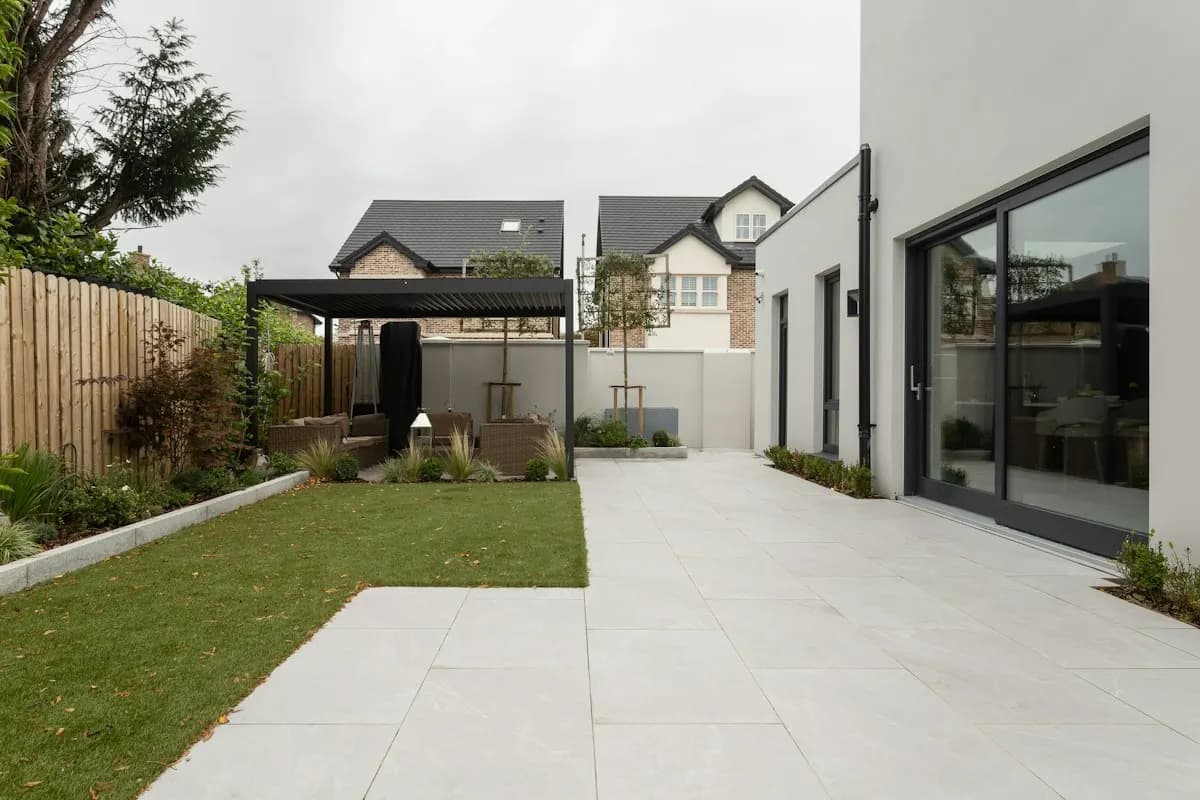
Patio Scopebook · Natural gas or propane fire feature vs Wood-burning fire feature
A gas fire feature lights instantly, makes no smoke or ash, is allowed where wood is banned and can sit closer to seating, but costs more to install because of the line and permit. A wood feature is cheaper to build, hotter and more atmospheric, but needs clearances, produces smoke and embers, and is restricted in many jurisdictions. Check burn rules first; they often decide it.
Photo: Tile Merchant Ireland · License.
Fuel is the first decision on any fire feature because it decides everything downstream: where the unit can go, what permits apply, who installs it and what it costs to run. It also decides how often it is used. Gas features get lit on an ordinary Tuesday; wood features get lit when someone has time to build a fire and clean up after it. Houzz's 2026 Outdoor Trends Study found 18% of outdoor renovators adding a fire feature, and most of those decisions come down to this page.
The verdict above summarises the trade. Below are the scenarios where each wins, the install and ten-year cost, climate and burn-rule effects, resale, common mistakes and what the two kinds of bid should contain. Lawn Love's December 2025 average of $830 for an installed fire pit and HomeAdvisor's June 2026 figures for fireplaces anchor the numbers.
Gas gives instant, smokeless flame that is allowed where wood is banned but costs more to install because of the line; wood is cheaper, hotter and more atmospheric but brings smoke, ash, clearances and seasonal burn restrictions.
| Factor | Natural gas or propane fire feature | Wood-burning fire feature |
|---|---|---|
| Upfront cost | $400 to $3,000 unit plus $14 to $25 per ft of gas line (Lawn Love); fireplaces $1,800 to $3,500 | $250 to $2,200 pits; masonry fireplaces $2,000 to $3,200 and up (HomeAdvisor) |
| Lifespan | Burner 10 to 15 years; masonry longer | Liner 10 to 20 years with fire brick or steel; masonry longer |
| Maintenance | Annual burner and valve check; keep pan drained | Ash removal; liner inspection; cap sealing |
| Appearance | Clean flame over glass or lava rock; no smoke | Real fire, crackle, smoke plume |
| Climate fit | Allowed in most burn-restricted areas; pan must drain in wet climates | Suits rural and cool regions; banned seasonally in much of the West |
| Install time | Line trenched before the patio base; 1 to 3 days plus permit | 1 to 2 days on a prepared pad |
| Resale | About 56% recovery for a $9,000 gas feature with patio (NAR 2023) | Similar; lifestyle purchase either way |
| Best for | Suburban lots, tight clearances, frequent short evenings, burn-ban regions | Rural lots, big clearances, occasional long evenings, cooking |
Gas wins on suburban lots with neighbors close, in any region with seasonal burn bans, and for people who will light it for forty minutes on a Tuesday. The line is the cost and the timing: it has to be trenched before the patio base goes down, which is why the fuel decision belongs in the first plan. NAR's report shows fire features are bought for livability, not resale, at 78% citing added features and livability as the motive.
Wood wins where clearances are generous, rules permit it, firewood is easy and the point is the fire itself: cooking, long evenings, a rural setting. Build it with a steel or fire-brick liner and a drain, keep it on a non-combustible pad well away from structures, and check the municipality's setback and the manufacturer's clearance before buying. See the fire feature page for the placement rules that apply to both fuels.
Gas wins in any jurisdiction that restricts open wood burning, which includes much of the West and many dense suburbs, and on any lot where the fire pit must sit within the clearance a wood fire would violate. It wins under a pergola or near a covered patio if the unit is listed for it, on a patio used for dining where smoke would be unwelcome, and for households that want to use the feature often and briefly. It wins for anyone who does not want to store, split or buy firewood.
It also wins where the patio is being built now, because running the line during the base work is cheap. A natural gas line from the meter runs $14 to $25 per linear foot on the site's cost table, and the same trench can carry the sleeve for lighting; put that lighting on a timer, since our analysis of the EIA's 2024 household survey found 43.4% of homes leave outdoor lights on all night. Houzz's 2026 Outdoor Trends Study found 18% of homeowners renovating outdoors are adding a fire feature, and one trench is the cheap way to serve it. The fire feature page explains what a licensed gas installer does on the day.
Wood wins where burning is allowed year-round and the lot is large enough for generous clearances, where the feature is a destination at the far end of the yard rather than beside the dining table, and where the homeowner wants real heat on cold nights. It wins on cost when no gas line is nearby and propane tanks are unwelcome. It wins for the ritual: the crackle, the smell and the cooking are why many people want a fire pit in the first place.
The NAR 2023 report found 78% of fire feature owners built one to add features and improve livability, and for many of them livability means a wood fire. Wood also suits a masonry fireplace with a proper chimney, which handles smoke far better than an open pit. What wood cannot do is escape the burn calendar: on a red-flag day it stays cold. Houzz's 2026 outdoor study found 34% of renovators want better space for entertaining; if guests are the point, count how many evenings the rules will let you light it.
A built-in wood pit typically runs $1,000 to $3,000 on the site's cost table. A built-in gas pit is $400 to $3,000 for the unit plus the line and a plumbing permit, so commonly $2,000 to $5,000 installed, and the site's calculator adds $3,500 for a gas pit with a moderate line run. Outdoor fireplaces range from $1,500 to $8,000 for block or prefab units according to HomeAdvisor, with an average of $3,000, and custom masonry far above that in either fuel.
Running costs favor gas per evening. A natural gas pit burns a few cents an hour; propane a dollar or two; a cord of firewood costs $200 to $500 in most regions and lasts a season of weekend fires. Over ten years a moderately used wood pit spends more on fuel and on relining or rebuilding a cracked ring; a gas pit spends on burner cleaning and eventual replacement of the burner and valve. The fire feature cost page itemises these lines.
| Item | Wood built-in pit | Natural gas built-in pit |
|---|---|---|
| Install | $1,000 – $3,000 | $2,000 – $5,000 with line and permit |
| Permit | Sometimes, fire code | Plumbing or gas permit |
| Installer | Mason or hardscape contractor | Plus licensed gas fitter |
| Fuel per season | $200 – $500 in firewood | Tens of dollars |
| Ten-year upkeep | Ash removal, liner or ring repair | Burner cleaning, valve or igniter |
| Use on burn-ban days | No | Usually yes |
In the arid West, wildfire rules and air quality districts restrict wood burning for much of the year and many jurisdictions ban open wood fires outright; gas is usually the only permanent option. In the humid Southeast and the Northeast, wood is generally permitted and firewood is cheap, but dense neighborhoods add smoke complaints and local nuisance rules. In the Midwest, winter burn bans are rare but frost heave affects both features' footings equally.
Wind is a climate factor homeowners forget. An exposed patio with prevailing wind sends wood smoke into the seating and can blow out a gas flame; a wind guard helps gas more than it helps wood. The regional page on this site notes which areas restrict wood, and the permits guide covers the three sets of rules that apply.
NAR's 2023 report estimated 56% cost recovery for a gas fire feature with a flagstone patio, lower than a plain patio because the project cost more. It did not score a wood feature separately. Buyers in restricted jurisdictions value gas because it works; buyers in rural areas rarely care which fuel, and a permanent masonry fireplace of either fuel presents as a feature while a rusted steel ring does not.
The practical resale question is documentation. A gas feature with a permit, pressure test and shutoff is an asset; one installed without them is a disclosure problem. A wood feature that violates local clearance rules may have to be removed before sale. Either way, build it to be shown, not hidden.
Gas mistakes: an enclosure without vents, so gas pools; a burner too small for the pit, giving a weak flame; no key valve or shutoff within reach; a line run without a permit or pressure test; lava rock or glass piled over the burner so it cannot breathe; and a propane tank enclosure that traps heat. Wood mistakes: no firebrick liner, so the ring cracks; the pit too close to a fence, tree canopy or the house; no ember screen; a patio surface that scorches; and no plan for ash.
Both share the placement mistake: the feature ends up where it fits rather than where people will sit around it. Design the seating circle first, then the pit at its center. The planning quiz asks about clearance because it is the rule most often broken.
A gas bid should name the unit and its listing, the burner size in BTU, the line material, size and length, the licensed installer, the permit, the pressure test, the shutoff location, the ignition type and any electrical, and the venting of the enclosure. A wood bid should name the ring or firebox, the liner, the footing, the clearances measured to the nearest structures and overhangs, the screen, and any local approval. Both should state the footing and how the feature ties into the patio base.
Ask both bidders to confirm the local burn rules in writing; a professional who works in your jurisdiction will know them. The estimate request asks for fuel preference and the distance to the house so proposals can address clearance and line length from the start.
Homeowner polls
No votes yet. Yours will be the first. · saved on this device
Houzz's 2026 study found shade structures in 35% of outdoor projects.
No votes yet. Yours will be the first. · saved on this device
A masonry pit can be retrofitted with a gas burner kit if it has a drain and an opening for the line, but the line itself still has to reach it, which means cutting the patio or running it above ground. If gas is a possibility, have a capped stub-out trenched under the patio during the build; it costs a few hundred dollars then and avoids a cut and patch later.
Wood, by a wide margin at the same size; a wood fire radiates in all directions and can be built up. A typical 60,000 BTU gas burner warms people within about four to five feet on a cool night but will not heat a patio on a cold one. Gas fireplaces with a back wall reflect more heat forward. Buy gas for ambiance and shoulder-season evenings, wood for real warmth.
Propane gives the same flame and convenience without a line from the meter, using a hidden tank in an enclosure or a nearby larger tank. It costs more per hour and the tank needs refilling and a vented enclosure. Natural gas is cheaper to run and never runs out, but only if the meter is within reasonable trenching distance.
Not necessarily. Match-lit and push-button piezo ignitions need no power. Electronic ignition with a flame sensor and remote control needs a low-voltage or line-voltage circuit, which the site's cost table puts at $400 to $1,200. Run the conduit during the patio build whether or not you choose it now.
Enough to matter near seating, neighbors and open windows, particularly with damp or softwood fuel. Seasoned hardwood and a pit with good airflow reduce it; smokeless designs with secondary combustion reduce it further. A masonry fireplace with a chimney handles smoke far better than any open pit.
No. Gas pits are not built for the heat or the ash of a wood fire, and burning wood in one damages the burner and can void the listing. If you want both, buy a dual-fuel unit designed for it or build a wood pit with a separate gas log lighter.
It varies by jurisdiction; ten feet from structures is a common minimum, and twenty-five feet is required in some places, with additional rules on overhanging branches and combustible surfaces. Manufacturer listings for kit pits set their own distances. Check the local fire code before choosing a location, since the clearance often decides the fuel.
A fire table is a gas fire pit built into a dining or coffee-table height surround, usually portable or semi-portable, and often propane. It follows gas rules and listings, needs the same clearances and venting, and is a good option for small patios or renters. Built-in gas pits are usually lower and larger.
 ComparisonConcrete pavers vs Poured concrete
Poured concrete is the cheaper patio at about 60 percent of a paver price and installs in days, but it cracks where the ground moves and cannot be spot-repaired.
 ComparisonConcrete pavers vs Natural stone
Concrete pavers cost less, come in consistent sizes and can be replaced from stock; natural stone costs more, varies in every piece and never fades or wears out when laid at the right thickness.
 ComparisonPermeable interlocking pavers vs Conventional pavers
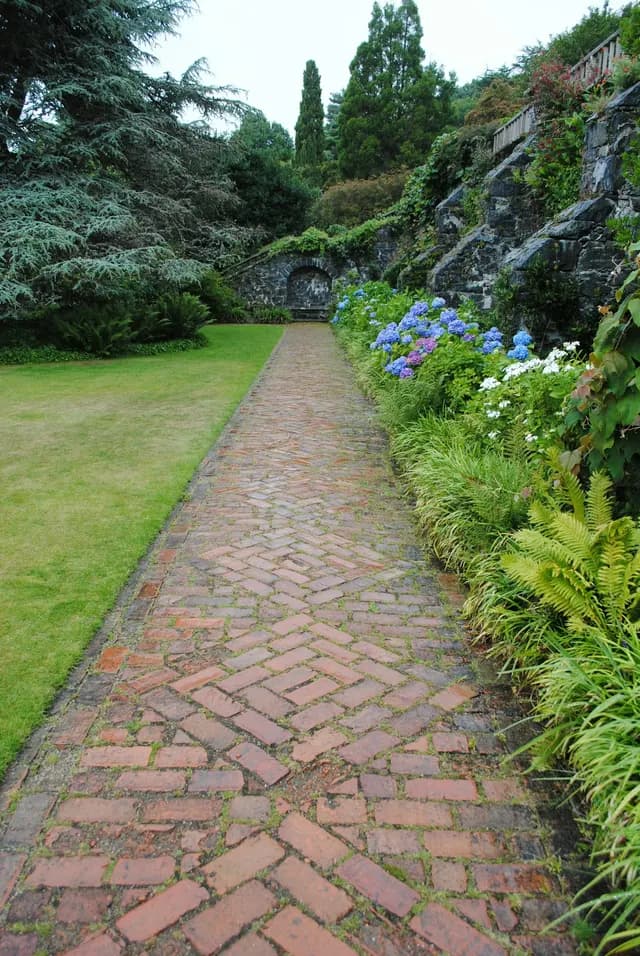
Permeable pavers pass rain through stone-filled joints into a deep open-graded reservoir, replacing the drain a conventional patio needs and often satisfying stormwater rules.
 ComparisonSegmental concrete block wall vs Pressure-treated timber wall
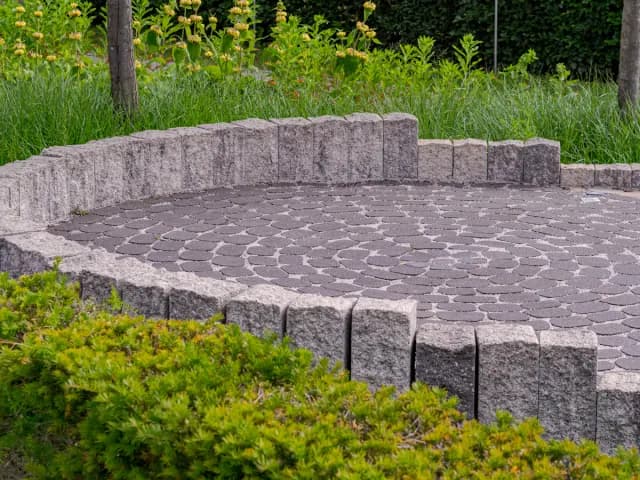
A pressure-treated timber wall is the least expensive way to hold a low slope and can be built in a day, but it rots at the soil line in fifteen to twenty-five years.
 Service guidePaver Patio Installation
Paver patio installation is the excavation, compacted stone base, bedding layer, laid pavers, edge restraint and joint fill that together create a level, drained outdoor surface.
 Service guideRetaining Wall Construction
Retaining wall construction turns a grade change into stable, usable ground with a footing, a wall of segmental block, stone, timber or poured concrete, and the drainage stone and pipe behind it.
 Service guideFire Pit & Fireplace Install
Fire pit and fireplace installation covers built-in wood or gas fire pits, masonry or prefabricated outdoor fireplaces, the non-combustible surface around them, gas or electrical lines and the clearances local rules require.
 Service guideWalkways & Driveways
Walkway and driveway work covers paths from the street or driveway to the door, garden paths, and vehicle surfaces in pavers, permeable pavers, concrete or stone.
 Service guideOutdoor Living Spaces
Outdoor living space planning coordinates patio, seating, cooking, shade, lighting, fire, paths, walls and planting into one plan that can be built at once or in phases.
 Free toolPatio cost calculator
Size, material tier and complexity in, a realistic budget range out.
 Free toolHardscape planning quiz
9 questions that show what you already know and what to check next.
 Free toolHardscape polls: how other homeowners are deciding
See what other planners chose and add your vote.
Tell us the size, the condition of what is there now, and what you want to change. Patio Scopebook passes your request to independent local professionals, who reply with written, no-obligation estimates. The service is free to use.