What total budget are you working with?
No votes yet. Yours will be the first. · saved on this device
Loading...
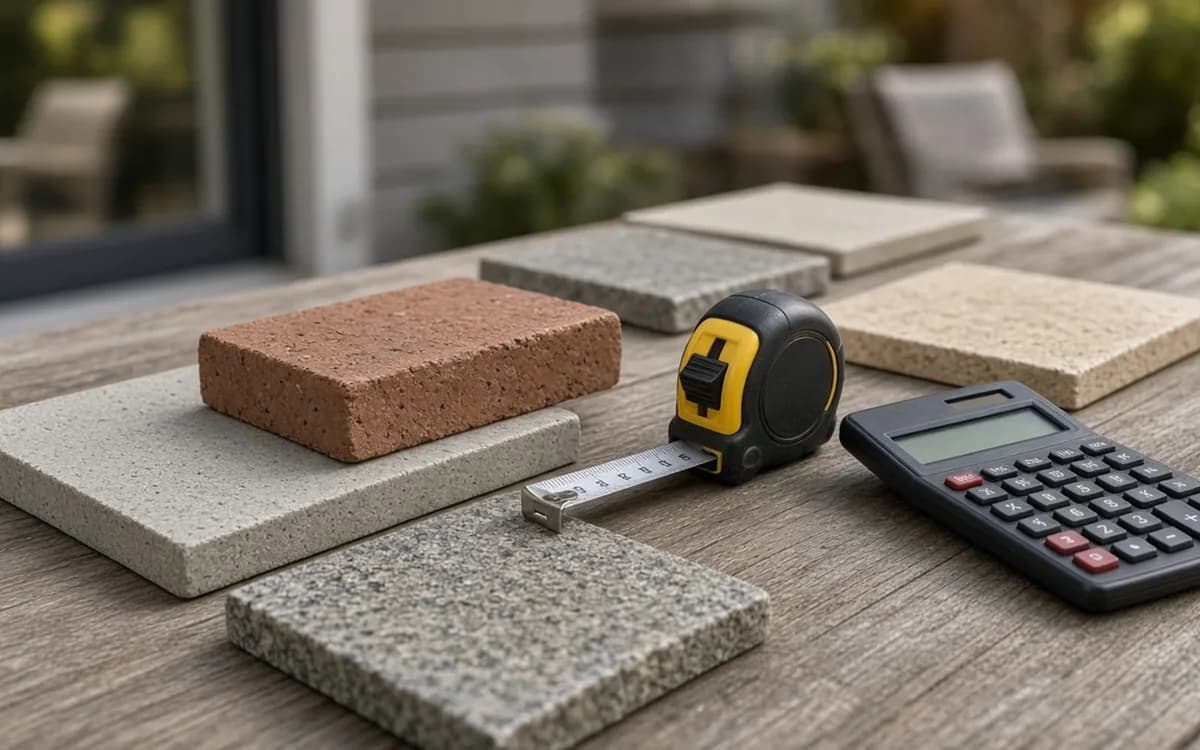
Patio Scopebook · Costs
In 2026 a professionally installed paver patio runs about $10 to $24 per square foot, a poured slab roughly 40 percent less, natural stone up to $30. Retaining walls cost $40 to $360 per linear foot by height, paver driveways $6,000 to $18,000, built-in fire pits $1,000 to $3,000. Labor is half or more of every figure, and site conditions move any of them by a fifth.
By Patio Scopebook editorial · Updated 2026-09-25
Hardscape prices are quoted per square foot because that is how materials are bought, but most of the money goes to people and machines. Excavation, hauling, base placement and compaction, cutting and laying are labor. On a paver patio the pavers themselves are typically a quarter to a third of the installed price. That is why two yards with the same pavers can differ by thousands, and why any figure below is a range rather than a number.
This guide uses published 2025 and 2026 benchmarks from HomeAdvisor, Angi, Lawn Love, HomeGuide, Fixr and the U.S. EPA. Each is named where it appears. Where a figure comes from the site's own service cost tables, it is presented as a range with the drivers explained, and the calculator applies the same benchmarks to your square footage.
Prices are national. Labor rates in coastal metros run well above the middle of every range; rural markets in the South and Midwest often sit near the bottom. Soil, access and material availability shift the figure again, which the regional section covers.
For a patio, Lawn Love's December 2025 guide gives $8 to $24 per sq ft installed. Angi's May 2026 benchmark puts a typical project at $2,029 to $6,088, and HomeAdvisor's June 2026 guide reports an average interlocking paver job of $3,400. Those figures describe modest patios; a 400 square foot paver patio with a border and steps commonly lands between $6,000 and $10,000 in a mid-cost market.
For walls, HomeAdvisor's June 2026 guide gives an average of $6,084, with the per-foot price climbing steeply with height. For driveways, the same publisher puts a paver driveway at $12,000. For walkways, Lawn Love's December 2025 figure is $13 to $27 per sq ft. For fire features, Lawn Love reports an average installed fire pit of $830 and HomeAdvisor an average outdoor fireplace of $3,000.
| Scope | Typical 2026 range | Unit | Main driver |
|---|---|---|---|
| Poured concrete patio | $6 – $14 | per sq ft | Finish, thickness, access |
| Concrete paver patio | $10 – $24 | per sq ft | Base depth, pattern, border |
| Natural stone patio | $12 – $30 | per sq ft | Stone type, thickness, region |
| Permeable paver patio | $7 – $14 | per sq ft | Reservoir depth, stone cost |
| Retaining wall | $40 – $360 | per linear ft | Height, geogrid, engineering |
| Paver walkway | $13 – $27 | per sq ft | Width, curves, steps |
| Paver driveway | $6,000 – $18,000 | per project | Area, base depth, demo |
| Built-in fire pit | $1,000 – $3,000 | per unit | Fuel, gas line length |
A 400 square foot paver patio uses roughly ten tons of base stone and a ton of bedding sand, all of which is delivered, moved, spread in lifts and compacted. It uses about 450 pavers, each handled at least twice, with ten to fifteen percent cut. The pavers might cost $3 to $6 per square foot at a supply yard; the installed price is three to four times that. The difference is excavation, hauling, base, compaction, screeding, laying, cutting, edging, sanding and cleanup.
This is why price differences between contractors mostly reflect labor rates and how much base they intend to place, not the paver. It is also why hand-carried sites cost so much more. If a skid steer cannot reach the yard, every ton of stone goes through the gate in a wheelbarrow, which can add a day or two and a fifth to the price. The paver patio page explains what each day of the build involves.
Upward drivers, in rough order of impact: hand access instead of machine access; clay or wet subgrade needing a deeper base and geotextile; demolition of an old slab, which HomeAdvisor and the site's cost tables place at $550 to $1,700; diagonal or herringbone patterns with more cuts; curves and multiple borders; steps and level changes; drainage work such as a French drain, typically $1,000 to $3,000; and separate scopes such as walls, gas lines and lighting added to the same project.
Downward drivers: a rectangular layout with a simple running bond; a flat, well-drained lot with machine access; building in the contractor's slower season; choosing a regional stone or a standard paver line stocked locally; and combining scopes in one mobilisation. HomeAdvisor puts a professional paver installation at 4 to 10 days, so every scope added shares one setup, while Lawn Love's $8 to $24 per sq ft installed range shows how far the surface moves price. Bundling is the better lever; cheaper base is the wrong one.
Labor is the biggest regional variable. A crew day in the Northeast or on the West Coast can cost double one in the rural South, and because labor is half or more of the job, the installed price moves with it. Material costs vary less, except for natural stone, which is cheap near the quarry and expensive a thousand miles away. Pennsylvania bluestone, Texas limestone and Arizona flagstone each have a home market where they compete with concrete pavers on price.
Climate changes the specification, which changes cost. Frost regions need deeper bases and open-graded stone that drains, adding material and excavation. Expansive clay in the West and parts of the South often requires geotextile and a thicker base. Storm-intense regions may require stormwater controls, and municipalities with impervious cover limits can push a project toward permeable pavers, which the EPA prices at $7 to $14 per sq ft. Expect the calculator's bracket to shift 20 to 30 percent between regions.
Permits and engineering are the most common. A retaining wall over the code threshold needs a permit fee, typically $50 to $500, and often an engineer's design, which HomeAdvisor puts at $350 to $750. Gas fire features need a plumbing permit and a licensed gas fitter, and a natural gas line from the meter runs $14 to $25 per linear foot on the site's cost table. Electrical for ignition or lighting adds $400 to $1,200 for a circuit.
Then come the finishing costs homeowners forget: sealing, which HomeGuide prices at $1.50 to $3.25 per sq ft and is optional; landscape repair where equipment crossed the lawn; disposal fees for spoil and old concrete; and utility locates for private lines that 811 does not mark. Upkeep matters over the long run: Virginia Cooperative Extension gives permeable pavement a service life of 20 to 30 years when it is maintained. Finally, the cost of not doing something: skipping edge restraint or polymeric sand saves a few hundred dollars now and costs a relay later. The permits guide covers the approval costs in more detail.

A complete bid names the excavation depth, the base material and compacted thickness, the bedding material, the paver product and thickness, the pattern and border, the edge restraint type, the joint sand, the drainage measures and the disposal. It states who pulls permits, what the schedule is and how payment is staged. It separates walls, steps, fire features, gas and electrical into their own lines with their own prices. If any of that is missing, the bid is a surface price.
Compare bids on the base line first. A six-inch compacted base of crushed stone in two lifts, over geotextile on clay, is a normal specification for a patio. Four inches on clay is not. A bid that is 20 percent cheaper and two inches thinner is not a bargain. Next compare edge restraint and joint material, then drainage. Only then compare price. The Fixr comparison of a 120 square foot patio, $1,310 to $1,770 vs $865 to $1,085, shows how much of the pavers-versus-concrete difference is real; the rest is specification.
A small patio, around 200 square feet of concrete pavers on a flat, accessible lot with a simple border, typically lands at $3,000 to $5,000, which sits inside Angi's benchmark. A mid-size project, 400 square feet with a border, two steps to the door and a catch basin, commonly runs $7,000 to $12,000. A large project, 700 square feet with a seat wall, a gas fire pit and lighting, moves into the $20,000 to $35,000 range once the wall, gas line and electrical are counted as their own scopes.
A four-foot block retaining wall forty feet long, without engineering, typically prices at $5,000 to $11,000; the same wall at six feet with an engineer's design and geogrid can double. A paver driveway of 600 square feet with demolition of the old concrete usually falls within HomeAdvisor's $6,000 to $18,000 range, with the base depth deciding where. The wall cost page and driveway cost page break these down further.
The NAR 2023 Remodeling Impact Report estimated 95% of a modest paver patio's cost recovered at resale, and 56% for a gas fire feature with flagstone patio. Zonda's 2025 Cost vs. Value data, as reported by Opendoor, put a backyard patio addition at 46%. The gap reflects project scale: a modest patio on a finished lot returns most of its cost, an elaborate one returns less.
The practical reading is to spend on what a buyer can see fail: level, dry, well-edged surfaces. Fixr's 2025 expert survey found 98% of outdoor-industry professionals believe updated outdoor spaces significantly affect value. Expensive pattern work and premium stone return less than a correctly built base, and a leaning wall subtracts from the sale. Budget for the base first.
Homeowner polls
No votes yet. Yours will be the first. · saved on this device
No votes yet. Yours will be the first. · saved on this device
No votes yet. Yours will be the first. · saved on this device
Broom-finished poured concrete on a compacted base, at roughly $6 to $14 per square foot installed. It will crack at the control joints and cannot be spot-repaired, but it lasts decades on stable soil. Concrete pavers cost more but can be lifted and relaid. Gravel or decomposed granite is cheaper still but is not a finished patio surface for furniture.
Plan on $15 to $20 per square foot in a mid-cost market for a standard concrete paver, border, six-inch base and polymeric sand, based on Lawn Love's $8 to $24 range and Angi's per-project benchmark. Add steps, walls, drainage, demolition and features as separate lines. Coastal metros and hand-access sites push toward or above the top of the range.
Because contractors estimate wall face area from height and length, and per-linear-foot ranges are stated by height band. HomeAdvisor's $40 to $360 per foot spans a two-foot garden wall to a six-foot engineered wall. Always confirm the height the quoted rate assumes, and whether geogrid, drainage stone and pipe, cap and engineering are included.
Yes, usually by the cost of the gas line and its permit. The built-in unit itself is comparable, but a natural gas run from the meter at $14 to $25 per linear foot, a licensed gas fitter and a plumbing permit can add $1,000 to $3,000 depending on distance. Propane avoids the line but adds a tank enclosure. Wood needs clearances and may be restricted locally.
Typically $550 to $1,700 for a residential slab, per the site's cost tables drawn from HomeAdvisor and Angi, depending on thickness, reinforcement and how far it has to be carried. Thick slabs with rebar or those in a fenced back yard with hand access cost more. Ask whether disposal fees are included, since dump charges for concrete vary widely by region.
The units cost about the same, and the EPA puts construction at $7 to $14 per square foot, overlapping conventional pavers. The difference is the base: permeable systems need a deeper open-graded stone reservoir, which adds excavation and stone but removes the need for a separate drain. On a site that would otherwise need a French drain, the totals are often close.
A deposit of ten to a third at signing to cover materials, a progress payment when the base is compacted or the wall is at grade, and the balance at completion after a walk-through. Paying in full before the base is inspected removes your leverage on the one part you cannot see later. Very large deposits for a small job are a warning sign.
Nobody can say with confidence. Labor rates have risen steadily, and the CMHA's production data shows paver output changed -9.9% in 2023, which usually points to softer demand rather than lower prices. Booking in the contractor's slower season is a more reliable saving than waiting for material prices to move.
They are accurate for the middle of the country on an ordinary lot and become less so as your site departs from that: tight access, clay, slopes, trees and premium materials all move the number. Use them to check whether a proposal is inside a plausible range, not to predict it. Two or three written estimates on the same brief are the real benchmark.
 Service guidePaver Patio Installation
Paver patio installation is the excavation, compacted stone base, bedding layer, laid pavers, edge restraint and joint fill that together create a level, drained outdoor surface.
 Service guideRetaining Wall Construction
Retaining wall construction turns a grade change into stable, usable ground with a footing, a wall of segmental block, stone, timber or poured concrete, and the drainage stone and pipe behind it.
 Service guideWalkways & Driveways
Walkway and driveway work covers paths from the street or driveway to the door, garden paths, and vehicle surfaces in pavers, permeable pavers, concrete or stone.
 Service guideFire Pit & Fireplace Install
Fire pit and fireplace installation covers built-in wood or gas fire pits, masonry or prefabricated outdoor fireplaces, the non-combustible surface around them, gas or electrical lines and the clearances local rules require.
 PlanningHow to plan a patio or hardscape project so nothing gets torn out later
Plan a hardscape project in the order it will be built: survey the site and map where water goes, decide the layout and levels, settle utilities and anything that must be buried, then choose surfaces and features.
 MaterialsPatio and hardscape materials: which surface, wall and fire feature fits your yard
Concrete pavers suit most yards because they are affordable, uniform and can be lifted and relaid.
 PermitsHardscape permits and codes: what triggers review, and what happens if you skip it
No, in most U.S.
 Free toolPatio cost calculator
Size, material tier and complexity in, a realistic budget range out.
 Free toolCompare hardscape options, row by row
Side-by-side tables for the decisions that change the price most.
 Free toolHardscape planning quiz
9 questions that show what you already know and what to check next.
 Free toolHardscape polls: how other homeowners are deciding
See what other planners chose and add your vote.
Tell us the size, the condition of what is there now, and what you want to change. Patio Scopebook passes your request to independent local professionals, who reply with written, no-obligation estimates. The service is free to use.