Which surface are you leaning toward for your patio?
The compare pages set each of these against the others.
No votes yet. Yours will be the first. · saved on this device
Loading...
Patio Scopebook · Service guide
Paver patio installation is the excavation, compacted stone base, bedding layer, laid pavers, edge restraint and joint fill that together create a level, drained outdoor surface. It suits homeowners who want a pattern and border, a surface that can be repaired unit by unit, and a project sized from a few hundred to a couple thousand square feet.
A paver patio is a system, and the pavers are the least important part of it. Lawn Love's December 2025 guide puts installed paver patios at $8 to $24 per sq ft, and inside that range the paver itself is usually $3 to $8 of the total. The rest is excavation, stone, compaction, bedding, cutting, edging and joint fill, which is another way of saying the rest is labor and the judgment behind it.
This page walks through the decisions in the order an estimator makes them on a site visit: what the soil and water are doing, how deep the base has to be, which paver suits the use and climate, and what the proposal should say so that three bids can be compared honestly. HomeAdvisor's June 2026 guide reports an average interlocking paver project of $3,400, with most between $1,500 and $7,000; the numbers below explain why yours may sit above or below that.
Want the numbers only? Read the paver patio installation cost guide for 2026 ranges, what moves the price, and sample budgets.
| Item | Low | High | Unit | Notes |
|---|---|---|---|---|
| Concrete paver patio, installed | $8 | $16 | per sq ft | LawnStarter 2024; includes base and labor on a reachable lot |
| Clay brick paver patio, installed | $14 | $24 | per sq ft | Fired-through color; tight patterns add cutting |
| Natural stone patio, installed | $12 | $30 | per sq ft | Up to $50 for thick or imported stone (HomeAdvisor 2026) |
| Permeable interlocking pavers | $7 | $14 | per sq ft | U.S. EPA fact sheet; deeper open-graded base |
| Remove existing concrete slab | $550 | $1,700 | flat | HomeAdvisor reference for slab removal and haul-away |
| French drain or catch basin | $1,000 | $3,000 | flat | Depends on run length and outlet |
| Professional sealing, later | $1.5 | $3.25 | per sq ft | HomeGuide 2026; every 3 to 5 years, optional |
Pavers suit anyone who wants a defined outdoor room with a pattern, a contrasting border and the ability to fix a settled corner without touching the rest. They handle freeze-thaw better than a slab because the joints flex, and a well-built one can be lifted and relaid decades later when a tree root or a utility repair demands it. NAR's 2023 Remodeling Impact Report gave a new patio a 9.9 / 10 Joy Score and found 85% of owners wanted to be home more afterward, which lines up with what installers hear: the patio changes how the house gets used.
They are the wrong choice when budget is the only criterion and the hold is short, when the area is a vehicle route (see driveways for the heavier base), or when the site has no outlet for water and no appetite for drainage work. A slab poured on saturated clay and a paver patio laid on it fail the same way; pavers just fail more visibly. Many buyers inherit a patio rather than choose one: our analysis of the Census Bureau's new-housing tables found 62.2% of new single-family homes completed in 2025 came with one, so check how a builder patio was based before designing around it.
Concrete pavers are the volume choice: consistent size, many shapes and colors, and the lowest installed cost at $8 to $16 per square foot in LawnStarter's guide. Their weakness is color fade on cheaper lines and a surface that can look uniform in a large field, which is why borders and two-tone patterns exist. Clay brick pavers cost more, $14 to $24 installed, but the color is fired through and never fades; they suit traditional houses and tight patterns like herringbone and basketweave.
Natural stone, from $12 to $30 and up to $50 per square foot in HomeAdvisor's data, gives variation no manufactured product matches. Flagstone, bluestone and travertine each behave differently: travertine stays cool underfoot in hot climates, bluestone handles freezing, flagstone splits if laid too thin. Permeable interlocking concrete pavers use wider joints and an open-graded base to drain rain through the surface; CMHA reports they were the only paver category to grow in 2023, up +5.8%, while overall paver production fell -9.9%. The compare pages set concrete against brick, stone and permeable side by side.
| Paver type | Installed cost per sq ft | Strength | Watch for |
|---|---|---|---|
| Concrete paver | $8 to $16 | Lowest cost, most shapes | Color fade on budget lines |
| Clay brick | $14 to $24 | Permanent color, classic patterns | Spalling in cheap or salvaged brick |
| Natural stone | $12 to $30+ | Unique appearance, long life | Thickness and bedding must match the stone |
| Permeable concrete paver | $7 to $14 (EPA) | Handles runoff, may earn fee credits | Needs outlet or deep reservoir; joints vacuumed |

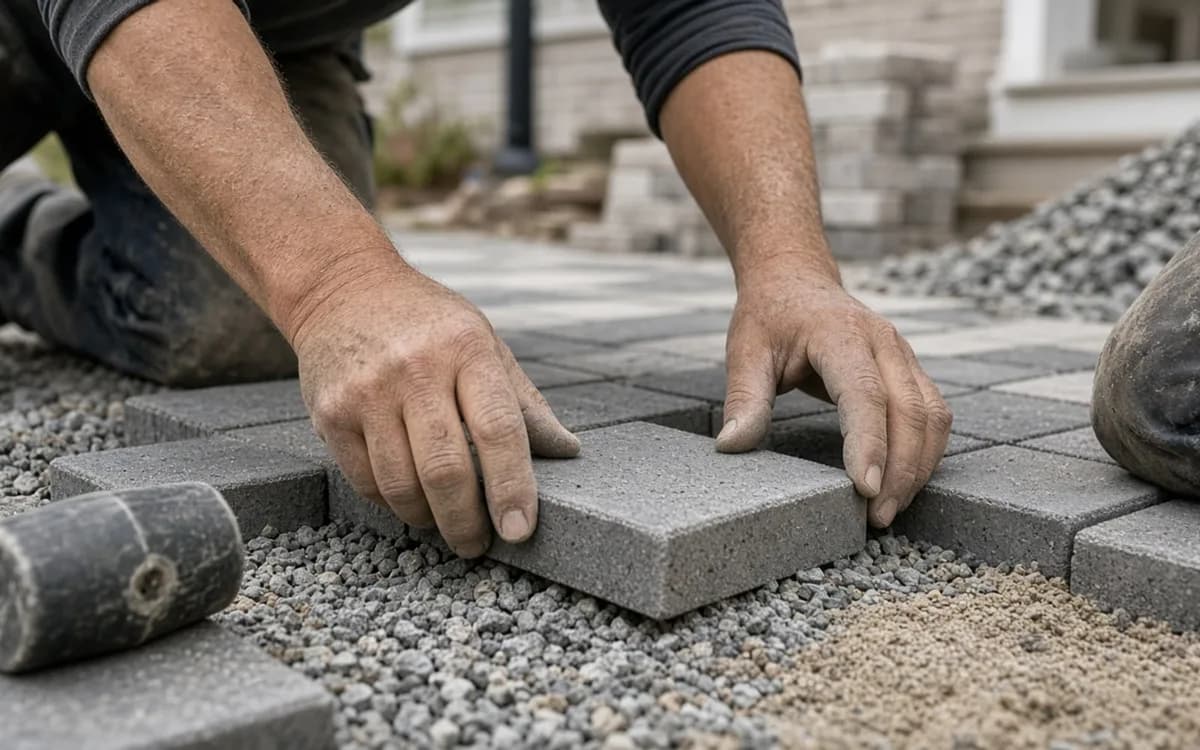
Start with excavation: topsoil and organic material out until undisturbed subgrade, usually eight to ten inches below the finished surface for a patio. In clay or wet soils a woven geotextile goes down first so the stone does not migrate into the mud. Then the base: crushed stone with fines, placed in lifts of no more than three or four inches and compacted with a plate compactor until it will not move. Six inches is the common minimum for foot traffic; eight or more where soil is soft or frost is deep. On top, one inch of coarse bedding sand screeded flat, never used to make up for a low base.
Edge restraint is the detail most often skipped in a cheap bid. Without it, the outer pavers walk outward, the joints open and the field loosens from the edge inward. Options are a poured concrete curb, spiked plastic or aluminum edging, or a mortared soldier course. Finally joint fill: polymeric sand for conventional pavers, small open-graded chip for permeable ones. Every one of these lines should appear on the proposal with a material and a dimension. The ones that do not appear are the ones that were not priced.
Angi's benchmark for patio installation is $2,029 to $6,088 per project, which fits a small to mid-sized patio without walls. A 400-square-foot concrete paver patio with a border on a reachable, flat lot typically lands between $5,000 and $8,000 in 2026; the same footprint in natural stone with a curved edge, a step and a seat wall can pass $18,000. The variables that move it are excavation and disposal (steeper for small gates and long carries), base thickness (soil-driven), cutting (curves and diagonals waste 10 to 15 percent of the material), and every vertical element.
Demolition of an existing surface is its own line, and so is drainage. HomeAdvisor's driveway guide prices removal of an old slab at $550 to $1,700, a fair reference for patios too. A French drain or catch basin can add $1,000 to $3,000 depending on run length and where the outlet is. Run your own numbers through the calculator, which starts from a mid-grade concrete paver and adjusts for tier, complexity and add-ons, then compare the bracket against the written proposals you receive.
HomeAdvisor's figure of 4 to 10 days is realistic for a 300 to 600 square foot patio with a professional crew of two or three. Day one is layout, string lines, utility locates confirmed and excavation. Days two and three are base placement and compaction, with the grade checked against the string lines at each lift; this is where slope is built in, and it is the stage to visit the site and look at the pitch yourself. Bedding sand and laying follow, then cutting the border and edges, setting edge restraint, sweeping in joint sand and compacting the field with a plate and pad.
Weather stretches the schedule: bedding sand cannot be screeded in rain, polymeric sand needs a dry surface and no rain for a day after activation, and frozen ground stops excavation. A crew promising a full patio in one day is planning a thin base or skipping compaction lifts, and either one shows up as settlement within two winters.

Settlement near downspouts and at the house wall is the most common complaint, and worn-out hardscape is why 41% of outdoor projects in Houzz's 2026 study began at all. It comes from water saturating an under-compacted base, often because the downspout discharges onto the patio or the backfill against the foundation was never compacted. Fix: extend downspouts past the patio in solid pipe, compact in lifts, and slope away from the house at roughly a quarter inch per foot. Edge creep is next: pavers at the outer edge drifting outward because restraint was skipped or the spikes were driven into loose fill. Fix: restraint on compacted base, not on bedding sand.
Weeds and ants in the joints mean the joint sand washed out; polymeric sand and periodic top-up prevent both. Efflorescence, the white haze on new concrete pavers, is harmless salt migration that weathers off in a season or cleans with a mild acid wash. Color fade is real on economy pavers in high-sun regions; ask for a through-colored or face-mix product if the patio bakes all afternoon. The planning quiz checks whether your soil and exposure make any of these more likely.
Less than a wood deck, more than nothing, which matters when Houzz's 2026 Outdoor Trends Study found 24% of surveyed outdoor renovators want easier maintenance or organization. Sweep and rinse seasonally, pull the occasional weed, and top up joint sand every few years where rain has washed it. Sealing is optional: it deepens color and resists stains but has to be redone. HomeGuide prices professional sealing at $1.50 to $3.25 per sq ft, which includes pressure washing and re-sanding joints, and most homeowners who seal do so every three to five years. Skip sealing on permeable pavers; it clogs the joints that make them work.
Permeable systems need their joints vacuumed or blown clear of fines every year or two so water keeps passing through. Virginia Cooperative Extension's homeowner fact sheet puts permeable pavement life at 20 to 30 years when maintained. If a section settles, the repair is what makes pavers worth their premium: lift the affected units, add and compact base, re-bed and relay.
In the Northeast and upper Midwest, frost depth drives base thickness and the choice of free-draining aggregate; a base that holds water will heave. Salt from adjacent walks and steps spalls some concrete pavers, so ask for a freeze-thaw rated product and avoid de-icing salts on new units the first winter. In the South and Gulf states, drainage volume from intense storms matters more than frost, and travertine or light-colored concrete pavers keep bare feet comfortable. In the arid West, expansive clay soils are the hazard: a geotextile, a thicker base and attention to irrigation overspray matter more than frost. The regional notes go into more detail for each area.
Build a short grid: base depth and material, geotextile yes or no, bedding depth, paver product and thickness, edge restraint type, joint material, slope and drainage route, demolition and disposal, and the written repair terms. A proposal that fills every cell is a proposal you can compare. One that offers a square-foot price and a paver name is a proposal for a surface, not a patio. Ask each pro whether their price includes a compaction test or at least a stated compaction method, and how they handle a sprinkler line or a buried cable they discover on day one; the answer tells you how they price surprises. When ready, the project brief page lists what to send so the matched pros can quote the same scope.
Patio Scopebook ran these numbers on the federal government's own household data. You won't find them in a contractor's brochure.
Patio Scopebook analysis · 2021–2025
| 2021 | 60.5% of 970,000 new homes (587,000) |
|---|---|
| 2022 | 62.9% of 1,022,000 new homes (643,000) |
| 2023 | 63.6% of 999,000 new homes (635,000) |
| 2024 | 62.9% of 1,019,000 new homes (641,000) |
| 2025 | 62.2% of 1,005,000 new homes (625,000) |
Change 2021–2025: +1.7 percentage points.
Patios are standard on a majority of new homes, so a new patio is often an upgrade or expansion rather than a first outdoor space.
Source: Patio Scopebook analysis of U.S. Census new-home tables from the U.S. Census Bureau. How we calculated it
Homeowner polls
The compare pages set each of these against the others.
No votes yet. Yours will be the first. · saved on this device
Curves and diagonals add cuts and waste; herringbone interlocks best.
No votes yet. Yours will be the first. · saved on this device
Drainage is priced before the surface on every well-written proposal.
No votes yet. Yours will be the first. · saved on this device
 Service guideWalkways & Driveways
Walkway and driveway work covers paths from the street or driveway to the door, garden paths, and vehicle surfaces in pavers, permeable pavers, concrete or stone.
 Service guideOutdoor Living Spaces
Outdoor living space planning coordinates patio, seating, cooking, shade, lighting, fire, paths, walls and planting into one plan that can be built at once or in phases.
 Service guideFire Pit & Fireplace Install
Fire pit and fireplace installation covers built-in wood or gas fire pits, masonry or prefabricated outdoor fireplaces, the non-combustible surface around them, gas or electrical lines and the clearances local rules require.
Plan about 12 by 14 feet, or roughly 170 square feet, for a six-seat rectangular table with chairs that can be pushed back and a path behind them. A lounge grouping of a sofa and two chairs needs a similar footprint. If both are wanted, 350 to 450 square feet is a comfortable total. Tape the layout on the lawn with the actual furniture before finalizing the size; most regrets are patios that are two feet too narrow.
Gentle slopes, up to about a 2 percent grade, are simply built into the surface so water runs off. Steeper yards need the patio terraced with a step or a low retaining wall so the finished surface is close to level. That wall is priced separately and, depending on height and what it holds, may need drainage stone and pipe behind it. Ask the installer to show the finished elevations relative to the door threshold and the lawn.
Standard concrete pavers for pedestrian use are 60 millimeters, about 2 3/8 inches. Driveways and anywhere a vehicle may roll call for 80 millimeters. Thin overlay pavers around 1 inch exist for setting over a sound existing slab. Natural stone should be at least 1 1/2 inches thick for a dry-set patio and thicker for irregular flagstone. Thinner material set on sand rocks and cracks.
It tends to hold value better than most discretionary outdoor projects. NAR's 2023 Remodeling Impact Report estimated a $10,500 dry-set paver patio recovers about 95 percent at resale, while Opendoor's summary of Zonda's 2025 data puts a larger patio addition near 46 percent. The takeaway is that a modest, well-built patio scaled to the house is the resale-safe version; an oversized one priced like an addition is a lifestyle purchase.
That is efflorescence, mineral salts carried to the surface by moisture as the concrete cures. It is cosmetic, common in the first year and usually weathers away with rain and sun. If it persists, an efflorescence cleaner or a diluted acid wash removes it; test a hidden area first because strong acid etches the surface. Sealing before efflorescence has run its course can trap it under the sealer, which is one reason installers wait to seal.
Herringbone at 45 or 90 degrees interlocks best and is the standard for driveways and anywhere the surface takes turning loads. Running bond is faster to lay and cheaper because of fewer cuts, fine for a patio. Random or modular patterns using three sizes hide small unevenness and suit natural-look pavers. Diagonal layouts and curves add 10 to 15 percent in cuts and waste, which shows up in the price.
Keep the finished paver surface at least one to two inches below the door threshold, and below the top of the foundation so it never contacts siding, weep holes or a wood sill. Slope the first ten feet away from the house at about a quarter inch per foot. If the door is high above grade, a wide step or two set on the same compacted base solves it more safely than raising the whole patio to meet the door.
Neither is required by code, but polymeric sand is the default on most professional installs because it resists washout, weeds and insects. It costs more and needs a dry, clean surface and careful activation. Regular joint sand works on a level patio with good drainage and can be topped up cheaply. Never use polymeric sand on permeable pavers, whose joints must stay open; those take small open-graded stone chip instead.
 Free toolPatio cost calculator
Size, material tier and complexity in, a realistic budget range out.
 Free toolCompare hardscape options, row by row
Side-by-side tables for the decisions that change the price most.
 Free toolHardscape planning quiz
9 questions that show what you already know and what to check next.
 Free toolHardscape polls: how other homeowners are deciding
See what other planners chose and add your vote.
Tell us the size, the condition of what is there now, and what you want to change. Patio Scopebook passes your request to independent local professionals, who reply with written, no-obligation estimates. The service is free to use.