If replacing a driveway, which surface would you choose?
No votes yet. Yours will be the first. · saved on this device
Loading...
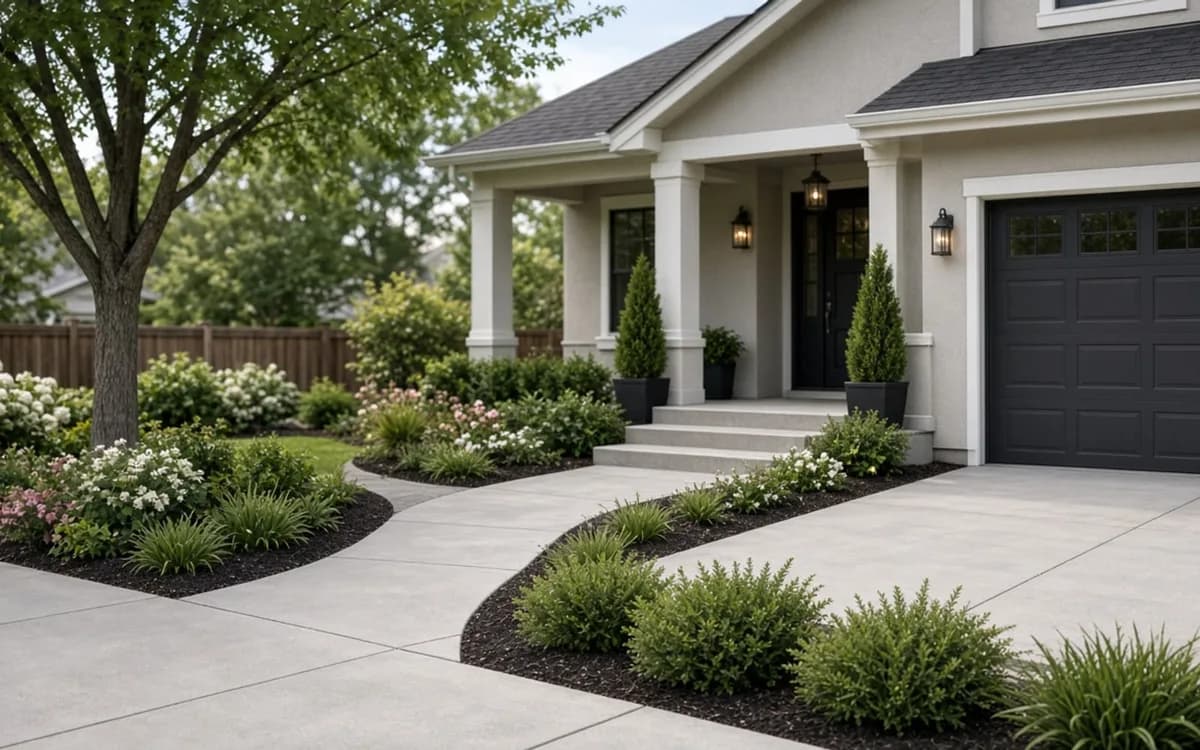
Patio Scopebook · Service guide
Walkway and driveway work covers paths from the street or driveway to the door, garden paths, and vehicle surfaces in pavers, permeable pavers, concrete or stone. It suits homeowners replacing a cracked or heaved surface, improving curb appeal before a sale, or solving runoff at the street. Vehicle areas get a thicker base, a thicker paver and stronger edges than paths.
A front walk and a driveway are the two hardscape elements that everyone sees, including the buyer. NAR's 2023 Remodeling Impact Report found 92% of Realtors have told sellers to improve curb appeal before listing, and the same report estimated that a $9,000 natural flagstone walkway with planters and planting recovers 100% of its cost at resale, the best return of any outdoor project it studied.
The design problem is that a path and a driveway look alike in pavers and are built completely differently. A person exerts a few pounds per square inch on a surface; a turning SUV exerts hundreds and adds shear. This page lays out what each surface costs, how the base changes with load, what permeable pavers do for runoff, and where the edges and transitions have to be detailed so the surface does not unravel from the outside in. Looks still lead: Houzz's 2026 outdoor study found 53% of renovators named appearance as a goal and 28% wanted the space to match the home's style, and the front walk is where both show.
Want the numbers only? Read the walkways & driveways cost guide for 2026 ranges, what moves the price, and sample budgets.
| Item | Low | High | Unit | Notes |
|---|---|---|---|---|
| Paver walkway, installed | $13 | $27 | per sq ft | Lawn Love 2025; 100 sq ft walk about $1,300 to $2,700 |
| Natural stone walkway, installed | $20 | $45 | per sq ft | Flagstone or bluestone; regional stone lowers freight |
| Concrete paver driveway, installed | $10 | $25 | per sq ft | HomeAdvisor 2026; 80 mm pavers on 10 to 12 in base |
| Permeable paver driveway, installed | $10 | $70 | per sq ft | HomeAdvisor 2026 upper range; EPA cites $7 to $14 construction |
| Remove old driveway | $550 | $1,700 | flat | HomeAdvisor 2026; thicker slabs cost more |
| Front steps and landing, pavers or block | $1,500 | $5,000 | flat | Per set; depends on rise and width |
| Trench drain at garage door | $800 | $2,500 | flat | Includes outlet to daylight or storm connection |
Replace when the surface is doing damage or is unsafe: a heaved walk that trips visitors, a driveway with cracks that lift in winter, an apron that sends water into the garage, or a path that is simply too narrow for two people. Replace when you are selling within a couple of years and the front of the house is the weakest part of the listing. Replace when the municipality is asking you to reduce impervious cover and a permeable driveway solves a stormwater fee.
Repair when the existing concrete is sound and merely stained, when a single settled section of pavers can be lifted and relaid, or when a good cleaning and sealing brings a surface back. Fixr's comparison shows pavers cost about 50 percent more than poured concrete for a patio, and the gap is similar for walks; if the old slab has years left, a clean and seal for a few hundred dollars beats replacement. Lawn Love prices an installed paver walkway at $13 to $27 per sq ft; on a walk, concrete pavers instead of stone is a fair trade, a thinner base is not. Compare the paths through the compare tool.
A walkway carries people and the occasional wheelbarrow, so six inches of compacted crushed stone under an inch of bedding sand is adequate on decent soil, with 60 millimeter pavers on top. A driveway carries vehicles that brake, turn and park in the same spot every day, so the base grows to ten to twelve inches on good soil and more on clay, the paver goes to 80 millimeters, the pattern is herringbone for interlock, and the edge restraint is concrete rather than spike-down plastic. The bedding layer stays at one inch; a thicker sand layer under vehicles ruts.
This is why a proposal that quotes one square-foot price for the path and the driveway has not thought about loads. HomeAdvisor's 2026 guide puts a paver driveway at $12,000, with installed cost spanning $10 to $70 per square foot by material, while Lawn Love's December 2025 guide puts paver walkways at $13 to $27 per sq ft. Ask for the base depth, paver thickness and edge type for each surface separately.
| Element | Walkway | Driveway |
|---|---|---|
| Compacted base | 6 inches | 10 to 12 inches; more on clay |
| Paver thickness | 60 mm (2 3/8 in) | 80 mm (3 1/8 in) |
| Pattern | Any; running bond is economical | Herringbone for interlock under turning loads |
| Edge restraint | Spike-down plastic or aluminum | Concrete curb or mortared border |
| Bedding layer | 1 inch coarse sand | 1 inch coarse sand, never thicker |

Lawn Love reports a 100-square-foot front walk at about $1,300 to $2,700, with concrete pavers at $7 to $16 per square foot in materials, clay brick $10 to $19 and natural stone $13 to $36. Width drives the total more than material: a four-foot walk, comfortable for two people, is a third more area than a three-foot one. Steps, a landing at the door and lighting are separate lines. HomeAdvisor's driveway range of $6,000 to $18,000 typical, with concrete pavers at $10 to $25 per square foot installed, brick $10 to $45, natural stone $15 to $60 and permeable $10 to $70, reflects the thicker base and the demolition of what was there; removing an old driveway adds $550 to $1,700.
The apron at the street is a separate consideration. Many municipalities own the strip between the sidewalk and the curb and require a right-of-way permit, a specific material or a poured-concrete apron regardless of what the driveway is. Ask the pro whether the apron is included and what the public works department requires. The calculator gives a bracket for a paver surface; apply the driveway complexity tier for vehicle areas.
For lots with runoff problems, stormwater fees or impervious-cover limits, yes. Permeable interlocking concrete pavers use wider joints filled with small stone over an open-graded base that stores rain and lets it soak into the soil. The U.S. EPA's stormwater fact sheet cites construction costs of $7 to $14 per sq ft and removal of 67 to 81 percent of suspended solids, and notes some jurisdictions give stormwater-fee credits for permeable surfaces. CMHA's data shows permeable production grew while conventional pavers declined in 2023, which tells you installers are getting experienced with them.
The limits are soil and maintenance. Over heavy clay with no outlet, the reservoir fills and stays full; Virginia Cooperative Extension advises the base sit more than two feet above the seasonal high water table. Joints need vacuuming every year or two so fines do not clog them, and de-icing sand should be avoided. Virginia Tech's fact sheet puts permeable pavement life at 20 to 30 years when maintained. A pro should do a simple infiltration test before recommending them.
Surfaces fail at their edges and at every change of material. On walks, the edge restraint is skipped or driven into loose topsoil and the outer course drifts. On driveways, the edge takes the tire load of every turn into the garage and unravels without a concrete curb. At the garage slab, the street apron and any existing sidewalk, the paver surface must meet the neighbor surface at the same height with a solid, compacted base under the joint, or a lip forms that trips people and catches plows.
Grade is the other failure. A walk needs to shed water sideways, not down its length toward the door; a driveway needs to fall toward the street or a trench drain at the garage, never toward the garage. Downspouts should discharge past the surface, not onto it. Ask the proposal to state the slope of each surface and where its water goes; a trench drain at the garage door is a small line that saves a flooded garage.
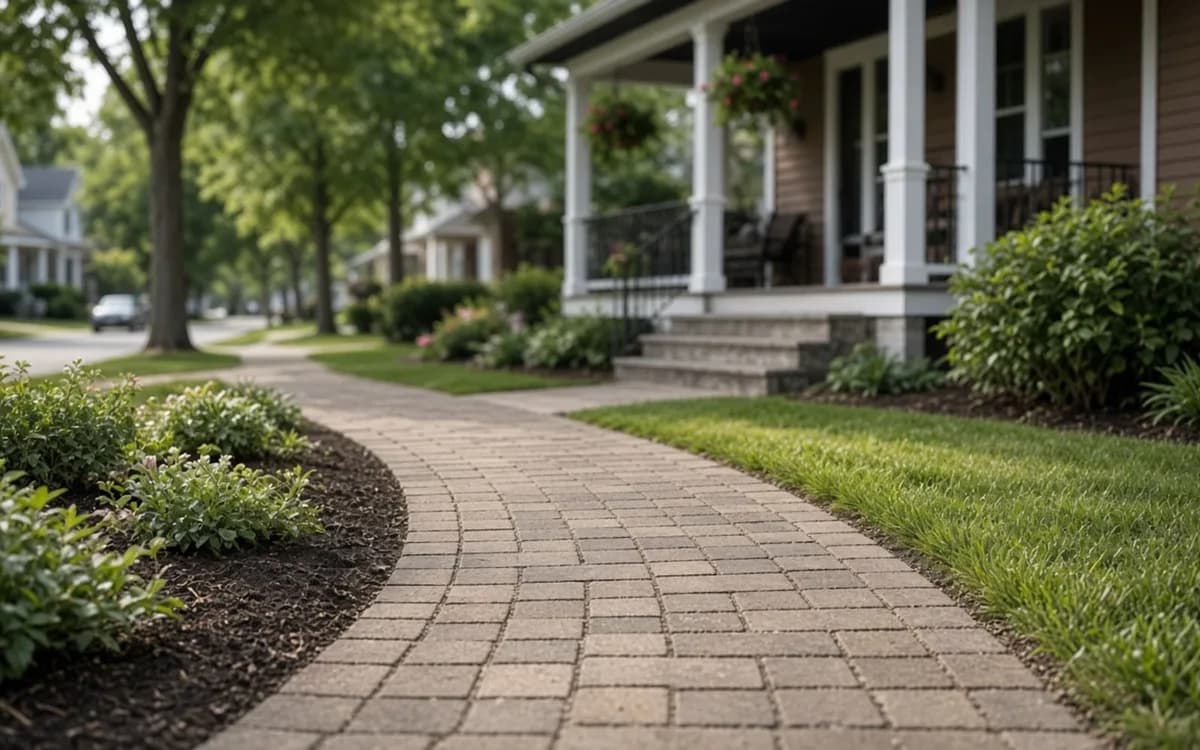
A 100 to 150 square foot front walk with a landing takes a crew two to four days: demolition and haul-away, excavation, base in lifts, bedding, laying, cutting the border, restraint and joint sand. A two-car driveway of 600 to 800 square feet runs one to two weeks because the excavation is deeper, the base is placed in more lifts and the compaction takes longer; add days if the old driveway is thick concrete. Weather delays follow the same rules as patios: no screeding in rain, no polymeric sand without a dry day. Right-of-way permits for the apron can add a couple of weeks at the front end.
In snow country, the driveway surface has to survive plows and de-icing salt: 80 millimeter freeze-thaw rated pavers, a border that plow blades cannot catch, and a base that drains so it does not heave. Consider sand instead of salt in the first winter. In the South, drainage volume from intense storms and heat-tolerant materials matter more; light pavers stay cooler. In arid regions with expansive clay, a geotextile separator and a thicker base keep the surface from cracking as the soil swells and shrinks. Where municipalities regulate stormwater, permeable pavers can turn a compliance problem into a design feature. The regional planning notes cover each area.
Ask each bidder to list, for each surface separately: demolition and disposal, excavation depth, base material and thickness, bedding, paver product and thickness, pattern, edge restraint, joint fill, slope and drainage, and treatment of every transition and the apron. Ask who obtains the right-of-way permit if one is needed and whether the proposal includes a compaction method. A bidder who quotes a single price per square foot for both the path and the driveway has priced the surface, not the structure. The project brief page lists what to send, including photos of the street connection and the garage threshold, so matched pros can price the transitions before they see them in person.
Homeowner polls
No votes yet. Yours will be the first. · saved on this device
No votes yet. Yours will be the first. · saved on this device
No votes yet. Yours will be the first. · saved on this device
 Service guidePaver Patio Installation
Paver patio installation is the excavation, compacted stone base, bedding layer, laid pavers, edge restraint and joint fill that together create a level, drained outdoor surface.
 Service guideRetaining Wall Construction
Retaining wall construction turns a grade change into stable, usable ground with a footing, a wall of segmental block, stone, timber or poured concrete, and the drainage stone and pipe behind it.
 Service guideOutdoor Living Spaces
Outdoor living space planning coordinates patio, seating, cooking, shade, lighting, fire, paths, walls and planting into one plan that can be built at once or in phases.
Four feet lets two people walk side by side and suits most front entries; three feet is the minimum for a secondary garden path. Five feet feels generous at a main entrance and gives room for planting to spill over the edge without narrowing the route. Width costs money in a straight line: a 30-foot walk at four feet is 120 square feet, at three feet it is 90. Lay it out with stakes before deciding.
Yes with the right base and paver. Heavy vehicles call for 80 millimeter pavers in a herringbone pattern over a 12-inch or thicker compacted base, sometimes with a cement-treated base or a concrete slab under the pavers for RV pads and turning areas. Tell the estimator the heaviest vehicle the surface will see, where it parks and where it turns. Standard driveway specs are designed for cars and light trucks.
Not if the surface is built correctly. A flush edge with a concrete restraint, a flat surface with no proud pavers and polymeric sand in the joints survive plowing. Ask the plow operator to use a rubber-edged blade or shoes, and avoid rock salt on new pavers the first winter; calcium chloride or sand is easier on the surface. Heaving comes from a base that holds water, not from the plow.
Most jurisdictions allow it and some encourage it with stormwater-fee credits or by not counting it as impervious cover. A few require an engineer's infiltration test or a specific base design, and some municipalities require the apron at the street to be conventional concrete regardless. Ask the building or public works department before designing, and ask the installer for local projects they have done.
Bring a paver from the patio, or its product name, to the supplier; many lines are still made and color batches can be blended. If the product is discontinued, choose a complementary color and separate the two surfaces with a border course in a third color so the difference reads as intentional. Matching pattern and joint width matters as much as color once the surfaces weather together.
Straight is cheaper, faster and reads as formal; it suits a symmetrical house and a short distance from drive to door. Curves add 10 to 15 percent in cuts and waste and need a reason, such as a tree to skirt or a view to open up. A gentle sweep with a wide radius looks intentional; tight wiggles look like an installer avoiding a stump. Draw it on the lawn with a hose first.
Talk to an arborist before cutting any root over two inches, since large roots stabilize the tree. Often the walk can be rerouted a few feet, bridged over the root zone on a thicker base with a root barrier, or built as a permeable surface that keeps the tree watered. Pavers are the right material near trees because they can be lifted and relaid as roots grow; a slab cracks and lifts.
No study prices a paver driveway alone, but NAR's 2023 report found the flagstone front walkway and planting upgrade recovered its full cost and that 92 percent of Realtors push curb-appeal work before listing. A driveway in good condition is expected; a cracked one costs you at the negotiating table. If the current surface is sound, a clean and seal may be the better pre-sale spend than replacement.
 Free toolPatio cost calculator
Size, material tier and complexity in, a realistic budget range out.
 Free toolCompare hardscape options, row by row
Side-by-side tables for the decisions that change the price most.
 Free toolHardscape planning quiz
9 questions that show what you already know and what to check next.
 Free toolHardscape polls: how other homeowners are deciding
See what other planners chose and add your vote.
Tell us the size, the condition of what is there now, and what you want to change. Patio Scopebook passes your request to independent local professionals, who reply with written, no-obligation estimates. The service is free to use.