What total budget are you working with?
No votes yet. Yours will be the first. · saved on this device
Loading...
Patio Scopebook · Cost calculator
This calculator estimates a patio budget from square footage, a material tier (poured concrete, concrete pavers or natural stone), a complexity level and optional add-ons such as a seat wall, fire pit, steps, lighting, drainage and demolition. It is anchored to Angi's 2026 patio benchmark and Lawn Love's per-square-foot range and produces a budget bracket to test against written proposals.
Skip to the calculatorBase rates are anchored to: Angi, How Much Does It Cost to Install a Patio? (2026); Lawn Love, Paver Patio Cost Guide (2025); HomeAdvisor, Interlocking Pavers Cost Guide (2026); Fixr, Pavers vs Concrete comparison (2024); HomeAdvisor, Interlocking Pavers Cost Guide (2026).
By the numbers
$2,029 to $6,088
typical patio installation cost per project (Angi, updated May 2026)
Angi's U.S. planning reference for a patio project. Retaining walls, fire features, major drainage changes and driveways need their own scope and price on top of this range.
Angi, How Much Does It Cost to Install a Patio? (2026)$8 to $24 per sq ft
installed cost of a paver patio; a 280 sq ft patio averages $3,350 (Lawn Love, December 2025)
Most projects run $2,275 to $6,950. Labor is $5 to $15 per square foot, or about $50 to $80 an hour. A DIY build of the same 280 sq ft patio came to $5,402 to $5,652 once tools and equipment were counted.
Lawn Love, Paver Patio Cost Guide (2025)$3,400
average interlocking paver installation, or $8 to $25 per sq ft (HomeAdvisor, June 2026)
Most projects land between $1,500 and $7,000. Concrete pavers run $8 to $15 per square foot, brick $10 to $20 and natural stone $15 to $50, so material choice can double the bill.
HomeAdvisor, Interlocking Pavers Cost Guide (2026)4 to 10 days
typical duration of a professional paver installation (HomeAdvisor, June 2026)
Excavation, base compaction and drainage prep account for most of that time. A quote promising a one-day patio usually means a thin base, which is the leading cause of settling and heaving later.
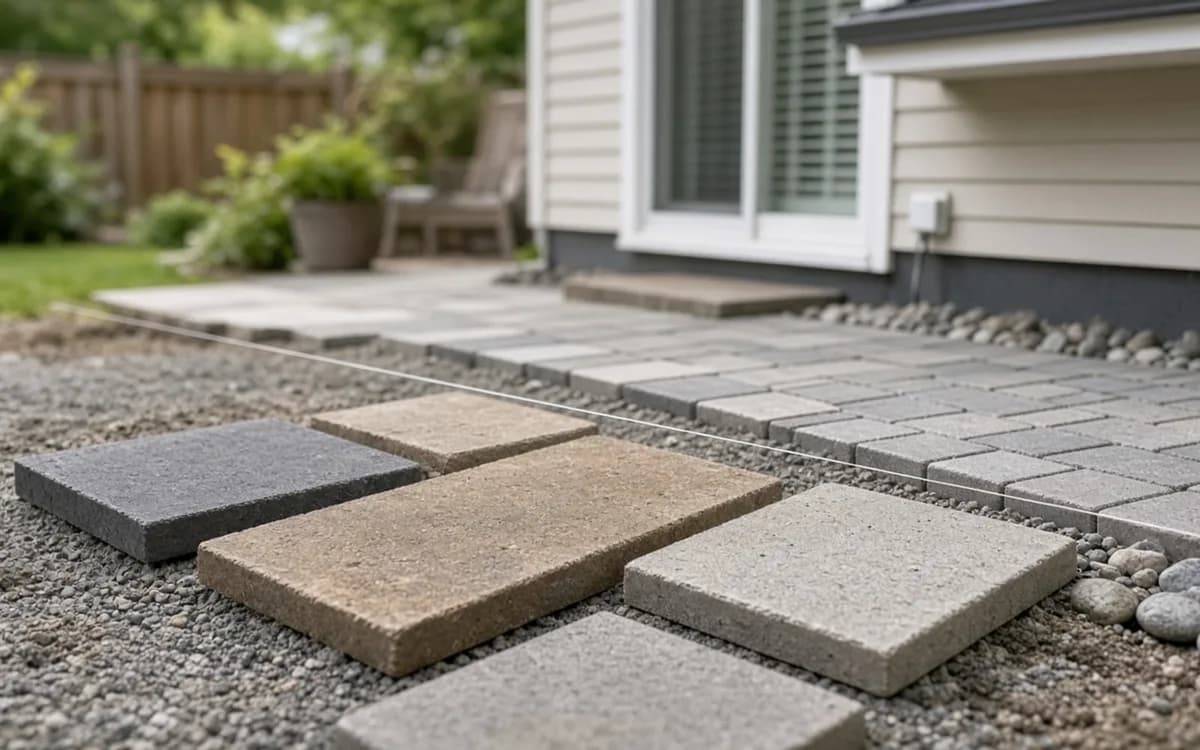
HomeAdvisor, Interlocking Pavers Cost Guide (2026)Enter the size you want, choose the surface and the site conditions, and the calculator returns a range that reflects what published cost guides report for 2025 and 2026. The base rate is a mid-grade concrete paver on an accessible, flat lot; the tiers and complexity factors move it toward a plain slab or a stone terrace with curves and steps.
Angi's benchmark for a patio installation is $2,029 to $6,088 per project, Lawn Love's December 2025 per-square-foot figure for pavers is $8 to $24 per sq ft and HomeAdvisor's June 2026 average for an interlocking paver job is $3,400. The calculator sits inside those figures and explains below what pushes a real estimate outside them.
The base rate is $17 per square foot, a dollar above the midpoint of Lawn Love's $8 to $24 range for installed pavers because it prices a bordered mid-grade paver, and it assumes six inches of compacted base, one inch of bedding, standard 60-millimeter concrete pavers in a running bond, spike-down edge restraint and polymeric sand. The material tier scales that: poured concrete with a broom finish and control joints at roughly 60 percent, natural stone at roughly 150 percent. The complexity factor reflects access and shape: a flat lot with machine access and a rectangle at 85 percent, moderate at 100 percent, and a tight-access yard with curves, a diagonal pattern and clay soil at 130 percent.
Add-ons are flat amounts drawn from the service pages: a seat wall, a gas fire pit with its line, a set of steps, low-voltage lighting, a French drain and demolition of an existing slab. Days are estimated from HomeAdvisor's 4 to 10 days for a typical install, scaled to size; permits, weather and the pro's schedule sit outside that.
Below the bracket: a thin base, no edge restraint, no drainage, no disposal, or a crew that is underpricing to fill a calendar. Ask for the missing lines. Above the bracket: retaining walls, which are priced per linear foot by height on the wall page; a driveway or vehicle area, which needs a thicker base and thicker pavers per the driveway page; a masonry fireplace instead of a pit; hand-carried excavation through a 30-inch gate; and a lot that needs regrading before the patio can be built. Fixr's comparison of $1,310 to $1,770 vs $865 to $1,085 for pavers versus concrete on the same footprint is a useful check on the tier factor.

Run the calculator twice: once for what you want and once for what you can afford. The gap tells you whether to reduce size, drop a tier or phase the extras; Angi's 2025 pulse found 71% of homeowners who hired a pro postponed a project, while 23% started early to beat price rises. Then put the size, tier, complexity, add-ons and bracket into the project brief so matched professionals price the same scope. When proposals arrive, compare each to the bracket and to each other line by line. The compare tool explains what the tier change buys, and the quiz checks that the surface you chose suits your soil and climate.
Homeowner polls
No votes yet. Yours will be the first. · saved on this device
No votes yet. Yours will be the first. · saved on this device
Start at 300 to 400 square feet: enough for a six-seat table with room behind the chairs plus a grill zone. If a lounge grouping around a fire pit is also wanted, 450 to 600 square feet. Tape the actual furniture on the lawn before deciding. Most homeowners who regret their patio size built one that was two feet too narrow rather than too small overall.
Because a proper concrete patio still needs excavation, a compacted base, forms, reinforcement, finishing and control joints, and Fixr's line-item comparison shows pavers at roughly 50 percent more than concrete for the same footprint, which is the same ratio expressed the other way. A concrete price much below that usually means a thin slab on unprepared soil, which cracks early.
It covers common dry-set stone such as bluestone, flagstone and travertine at national prices. Thick irregular flagstone mortared to a slab, imported stone or intricate patterns can exceed it; regional stone bought near its quarry can undercut it. HomeAdvisor's range for stone reaches $50 per square foot. Ask the pro to name the stone, its thickness and its setting method so you can place it against the tier.
Yes, unless a pro has confirmed the old slab is sound and can be overlaid. Removal and haul-away of a typical slab runs several hundred to around $1,700 per HomeAdvisor's reference for driveways, and pavers laid over a failing slab inherit its problems. The demolition add-on approximates that; a very thick or reinforced slab costs more to break out.
It does not, beyond the complexity factor. A slope of more than a few inches across the patio needs either a step or a low retaining wall to create a level surface, and that wall is priced separately by height and length. Choose the high complexity setting for a sloped site and add a wall estimate from the retaining wall page's reference table.
It covers a built-in gas pit with a moderate line run and a plumbing permit, in line with Lawn Love's ranges. A long run from a distant meter, a propane cabinet or an electrical ignition circuit add to it, and a masonry fireplace is a different scope starting around $3,000 and running past $20,000 for custom stone. The fire feature page has the itemized references.
Because labor is the majority of a hardscape price and complexity is a labor multiplier. Hand-carried excavation, extra cuts for curves and diagonals, a thicker base for clay, and working around trees and utilities can add half again to the hours. The material barely changes. That is why a pro's site visit, which is mostly an access and soil assessment, moves the number more than any paver choice.
 Free toolCompare hardscape options, row by row
Side-by-side tables for the decisions that change the price most.
 Free toolHardscape planning quiz
9 questions that show what you already know and what to check next.
 Free toolHardscape polls: how other homeowners are deciding
See what other planners chose and add your vote.
 Service guidePaver Patio Installation
Paver patio installation is the excavation, compacted stone base, bedding layer, laid pavers, edge restraint and joint fill that together create a level, drained outdoor surface.
 Service guideRetaining Wall Construction
Retaining wall construction turns a grade change into stable, usable ground with a footing, a wall of segmental block, stone, timber or poured concrete, and the drainage stone and pipe behind it.
 Service guideFire Pit & Fireplace Install
Fire pit and fireplace installation covers built-in wood or gas fire pits, masonry or prefabricated outdoor fireplaces, the non-combustible surface around them, gas or electrical lines and the clearances local rules require.
 Service guideWalkways & Driveways
Walkway and driveway work covers paths from the street or driveway to the door, garden paths, and vehicle surfaces in pavers, permeable pavers, concrete or stone.
 Service guideOutdoor Living Spaces
Outdoor living space planning coordinates patio, seating, cooking, shade, lighting, fire, paths, walls and planting into one plan that can be built at once or in phases.
Tell us the size, the condition of what is there now, and what you want to change. Patio Scopebook passes your request to independent local professionals, who reply with written, no-obligation estimates. The service is free to use.