What total budget are you working with?
No votes yet. Yours will be the first. · saved on this device
Loading...

Patio Scopebook · Paver Patio Installation cost guide
A professionally installed paver patio costs $8 to $24 per square foot, per Lawn Love's December 2025 guide. A typical 280-square-foot patio averages $3,350, and most projects fall between $2,275 and $6,950. Concrete pavers sit at the low end, clay brick and natural stone higher. Labor and base work take over half the price.
The cost table and calculator on this page give the ranges. This guide explains what sits inside them: how much of a paver price is labor, which tiers of paver change the figure, what the common add-ons cost, how the site and the schedule move the number, and what to cut when the estimate comes back high. It draws on Lawn Love's December 2025 guide, LawnStarter's installed prices by paver type, Angi's May 2026 benchmark and HomeAdvisor's June 2026 guide. The cost guide covers whole-yard budgets; this page is about the patio's own line items.
The single most useful fact is that the pavers are a quarter to a third of the installed price. A homeowner who spends the budget conversation on paver choice is negotiating the small part. The base, the edges and the drainage are where price and quality are both decided, and the service page explains the specification behind the numbers here.
| Item | Low | High | Unit | Notes |
|---|---|---|---|---|
| Concrete paver patio, installed | $8 | $16 | per sq ft | LawnStarter 2024; includes base and labor on a reachable lot |
| Clay brick paver patio, installed | $14 | $24 | per sq ft | Fired-through color; tight patterns add cutting |
| Natural stone patio, installed | $12 | $30 | per sq ft | Up to $50 for thick or imported stone (HomeAdvisor 2026) |
| Permeable interlocking pavers | $7 | $14 | per sq ft | U.S. EPA fact sheet; deeper open-graded base |
| Remove existing concrete slab | $550 | $1,700 | flat | HomeAdvisor reference for slab removal and haul-away |
| French drain or catch basin | $1,000 | $3,000 | flat | Depends on run length and outlet |
| Professional sealing, later | $1.5 | $3.25 | per sq ft | HomeGuide 2026; every 3 to 5 years, optional |
Start from Lawn Love's December 2025 installed range of $8 to $24 per sq ft. For a standard concrete paver, Lawn Love puts the units at $4 to $6 per square foot in material and labor at $5 to $15 per square foot, or about $50 to $80 an hour; base stone, sand, edging and joint material fill the gap. That labor covers excavation, hauling, base placement and compaction, screeding, laying, cutting, edging and cleanup. Delivery, disposal and a contractor's overhead sit inside those figures.
That split explains why HomeAdvisor's June 2026 average of $3,400 describes a small patio, and why Angi's benchmark of $2,029 to $6,088 is a range rather than a rate. Small patios carry the same mobilisation as large ones, so the per-square-foot price falls as area rises, until access or complexity pushes it back up.
Standard concrete pavers, 60 mm in a plain running bond, are the baseline at the bottom of the range. Textured, tumbled and multi-size concrete lines add $1 to $4 per square foot in material and a little labor for the random pattern. Clay brick pavers add more, at $14 to $24 installed on the page's table, and take more skill to lay tightly. Natural stone runs $12 to $30 depending on type and freight, and permeable pavers sit at the EPA's $7 to $14 per sq ft with a deeper base.
Pattern and border matter as much as tier. A herringbone or diagonal layout adds ten to fifteen percent in cuts and waste; a double border in a contrasting color adds material and layout time; a circle kit adds both. The calculator's three tiers capture the material step; the complexity setting captures the pattern and access step. The pavers versus stone page compares the top tiers directly.
| Tier | Installed 2026 range | What moves it |
|---|---|---|
| Standard concrete paver, running bond | $8 – $16 per sq ft | Base depth, access |
| Textured or multi-size concrete | $13 – $20 per sq ft | Pattern, border |
| Clay brick paver | $14 – $24 per sq ft | Tight joints, cuts |
| Permeable interlocking paver | $7 – $14 per sq ft plus reservoir | Reservoir depth, soil |
| Natural stone, dry-set | $12 – $30 per sq ft | Stone type, freight, thickness |
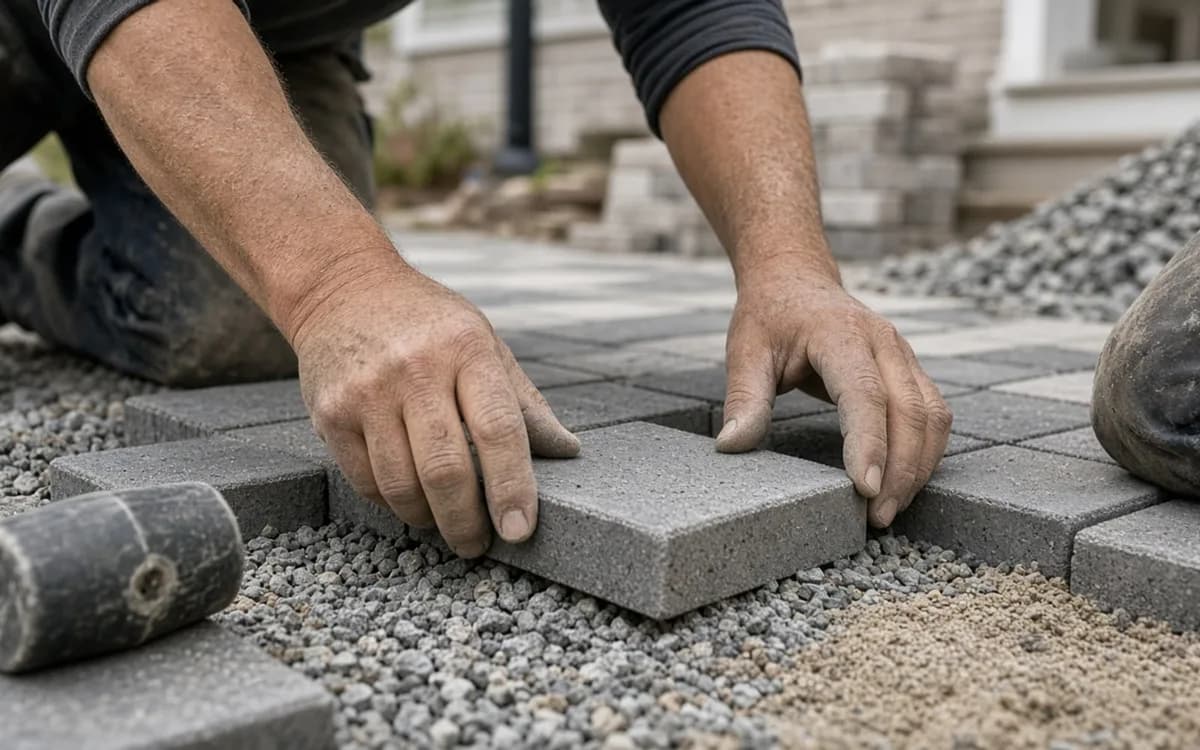
Steps to a door or grade change are the most common add-on, at roughly $1,800 for two or three paver or block steps on the calculator. A seat wall runs $150 to $300 per linear foot with a cap. A French drain or catch basin with an outlet adds $1,000 to $3,000. Removing an old slab adds $550 to $1,700. Low-voltage lighting adds $2,500 to $6,000 for a typical fixture count, and a built-in gas fire pit with its line adds around $3,500 as the calculator's add-on.
Sealing is optional and later: HomeGuide's 2026 figure is $1.50 to $3.25 per sq ft, usually applied after the first season once efflorescence has weathered off. The rule for add-ons is to price each as its own line so it cannot hide in the per-square-foot rate and so it can be deferred if the budget tightens. The calculator lets you toggle each to see its effect.
Access is the largest site multiplier. Machine access through a four-foot gate keeps the calculator at its simple setting; a yard reached only by wheelbarrow adds a day or two of hand hauling and can lift the price by a fifth or more. Soil is next: clay or wet subgrade needs geotextile and two or three extra inches of base, adding material and excavation and disposal of more spoil. Trees and utilities add hand digging and sometimes an arborist.
Season moves the price through availability. Late winter bookings for spring work often price better than April requests; late summer and autumn frequently combine dry soil with open schedules. HomeAdvisor's June 2026 timeline of 4 to 10 days means a small patio ties up a crew for about a week, so contractors price to fill gaps. Regional labor moves everything by 20 to 30 percent, as the cost guide explains.
A longer build is not usually more expensive on its own; crews price the work, not the days. What adds cost is interruption: a job split across two mobilisations because materials were late, a base left open in the rain and re-compacted, or a change order after the pavers are down. Ordering all material from one lot before the start, confirming the delivery date and settling the pattern and border on paper avoid most of it.
You can shorten the build by clearing the site yourself, arranging machine access and choosing a simple pattern, all of which also lower the price. You cannot safely shorten it by asking for one lift of base instead of two or by skipping the day the base is left to settle before laying. A schedule far below the HomeAdvisor range for the area is a warning about compaction, not a bargain. A professional build follows the sequence in the steps in this section.
Cut in this order. First, area: a patio ten percent smaller saves nearly ten percent of the cost and is rarely missed if the furniture layout was planned. Second, pattern and border: running bond with a single border saves cuts and material. Third, paver tier: a standard concrete line instead of a premium one saves $2 to $5 per square foot. Fourth, deferrable add-ons: lighting, seat wall and fire pit can wait if their sleeves and footings go in now.
Do not cut base depth, edge restraint, geotextile on clay, polymeric sand or drainage. Each saves a few hundred dollars now and creates a relay or a puddle later. Fixr's 120 sq ft comparison, $1,310 to $1,770 vs $865 to $1,085 for pavers versus poured concrete, shows where savings sit; the paver is the material to economise on, not the stone under it. The estimate request can ask for the base to be priced separately so it stays visible.
Multiply the area by Lawn Love's $8 to $24 per sq ft and you get the brackets in the table in this section. The 60, 280 and 500 square foot rows are Lawn Love's own; the square layouts are the same arithmetic applied to common patio dimensions. The low end is a plain concrete paver on an easy site, the high end brick or stone with a pattern and a border.
Treat the bracket as the surface only. Steps, a seat wall, drainage and demolition are separate lines, and very small patios cost more per square foot because setup and delivery are spread over fewer feet.
| Patio size | Area | Installed at $8 – $24 per sq ft (Lawn Love, Dec 2025) |
|---|---|---|
| Small pad | 60 sq ft | $480 – $1,440 |
| 10 × 10 ft | 100 sq ft | $800 – $2,400 |
| 12 × 12 ft | 144 sq ft | $1,152 – $3,456 |
| 16 × 16 ft | 256 sq ft | $2,048 – $6,144 |
| Lawn Love average patio | 280 sq ft | $2,240 – $6,720 (average $3,350) |
| 20 × 20 ft | 400 sq ft | $3,200 – $9,600 |
| Large patio | 500 sq ft | $4,000 – $12,000 |
Usually not by much. Lawn Love priced a DIY build of its 280-square-foot example at $5,402 to $5,652 once materials, tool purchases and rented equipment were counted, which overlaps the professional range for the same patio and sits above its $3,350 average. The saving is the labor line of $5 to $15 per square foot, and buying a plate compactor, saw and screed rails eats most of it on a single project.
The risk sits in the base. A homeowner can lay pavers neatly, but placing and compacting six inches of stone in lifts, holding a quarter inch per foot of fall and setting restraint is the work that decides whether the patio settles. DIY makes sense for a small, flat patio on well-drained soil when you can borrow the equipment; hire out anything with steps, walls, clay or a drainage problem.
The table in this section prices three complete scopes in a mid-cost market, built from Lawn Love's per-square-foot range, LawnStarter's installed prices by paver type and the add-on figures on this page. The smallest sits near the middle of Angi's benchmark of $2,029 to $6,088; the other two show how steps, walls, lighting and access stack onto the surface price.
In each case the base and labor are more than half. Where a proposal for one of these scopes comes in far below the range, the missing money is usually in base depth or edge restraint. Where it comes in far above, ask whether access or soil justified it. NAR's 2023 report found 95% of a modest paver patio's cost recovered at resale, which is another reason to spend on what lasts rather than what shows.
| Sample scope | Specification | 2026 range |
|---|---|---|
| 200 sq ft patio | Standard concrete paver, running bond, single border, flat lot with machine access | $3,000 – $4,500 |
| 400 sq ft patio | Textured multi-size paver, double border, two steps to the door, one catch basin, moderate access | $8,000 – $12,500 |
| 650 sq ft patio | Clay brick in herringbone, 20 ft seat wall, lighting, old slab removed, tight access on clay | $22,000 – $32,000 |
By the numbers
Planning figures from published U.S. sources; every card links to where the number came from.
$8 to $24 per sq ft
installed cost of a paver patio; a 280 sq ft patio averages $3,350 (Lawn Love, December 2025)
Most projects run $2,275 to $6,950. Labor is $5 to $15 per square foot, or about $50 to $80 an hour. A DIY build of the same 280 sq ft patio came to $5,402 to $5,652 once tools and equipment were counted.
Lawn Love, Paver Patio Cost Guide (2025)$3,400
average interlocking paver installation, or $8 to $25 per sq ft (HomeAdvisor, June 2026)
Most projects land between $1,500 and $7,000. Concrete pavers run $8 to $15 per square foot, brick $10 to $20 and natural stone $15 to $50, so material choice can double the bill.
HomeAdvisor, Interlocking Pavers Cost Guide (2026)$2,029 to $6,088
typical patio installation cost per project (Angi, updated May 2026)
Angi's U.S. planning reference for a patio project. Retaining walls, fire features, major drainage changes and driveways need their own scope and price on top of this range.
Angi, How Much Does It Cost to Install a Patio? (2026)$1.50 to $3.25 per sq ft
professional paver sealing cost (HomeGuide, 2026)
Pricing includes pressure washing, re-sanding joints and applying sealer; smaller jobs under 500 square feet sit at the top of the range. Most pavers are resealed every 3 to 5 years.
HomeGuide, Cost to Seal Pavers (2026)The calculator uses the same patios and hardscapes benchmarks as this guide. Set the size and tier, then request a written estimate to check it against a real proposal.
Homeowner polls
No votes yet. Yours will be the first. · saved on this device
No votes yet. Yours will be the first. · saved on this device
Curves and diagonals add cuts and waste; herringbone interlocks best.
No votes yet. Yours will be the first. · saved on this device
In a mid-cost market, $12 to $18 per square foot installed for a standard concrete paver with a six-inch base, single border and polymeric sand on an accessible lot, drawing on Lawn Love's $8 to $24 range. Coastal metros and hand-access sites push toward the top; rural markets and large simple areas sit near the bottom.
Mobilisation, equipment delivery, setup and cleanup cost about the same whether the patio is 150 or 500 square feet, so they are spread over fewer feet on a small job. Many contractors also carry a minimum charge. Expanding a small patio by a third often raises the total by much less than a third.
Roughly a quarter to a third. Lawn Love lists concrete pavers at $4 to $6 per square foot in material; premium lines run higher, and flagstone reaches $13 to $30. The rest of a $15 to $20 installed price is base material, edging, sand, labor, equipment, disposal and overhead.
Rarely. Contractors buy at trade prices that usually match or beat retail, take delivery on their schedule and handle shortages and returns. Owner-supplied material also removes the contractor's responsibility for lot matching and breakage. If a specific product matters to you, name it in the brief and let the contractor supply it.
Typically five to fifteen percent more than a rectangle of the same area, from the extra cutting and waste along the curve and the slower layout. Gentle curves cost less than tight ones. A soldier-course border along the curve hides the cuts and is usually included in the price of curving.
A few hundred dollars for a small area if the original pavers are lifted, the base corrected and the same units relaid; more if the base was the problem across the whole patio. This is the repair concrete cannot offer and is a large part of the case for pavers over a slab.
No. A deposit of ten to a third to cover materials is typical, with a progress payment when the base is compacted and the balance at completion. Half or more up front for a small job is unusual and removes your leverage on the base, the part you cannot inspect after the pavers go down.
 Retaining Wall Construction · Cost guideRetaining wall cost in 2026: why height changes the price faster than length
A residential retaining wall costs $40 to $360 per linear foot in 2026 depending mainly on height, with HomeAdvisor's June 2026 average at $6,084.
 Fire Pit & Fireplace Install · Cost guideFire pit and outdoor fireplace cost in 2026: from a paver pad to a masonry chimney
An installed fire pit averages about $830 in 2026 per Lawn Love, with built-in pits at $1,000 to $3,000; an outdoor fireplace averages $3,000 per HomeAdvisor, with most between $1,500 and $8,000 and custom masonry far higher.
 Walkways & Driveways · Cost guideWalkway and driveway cost in 2026: pricing the surface to the load
A paver walkway costs about $13 to $27 per square foot installed in 2026, per Lawn Love, and a paver driveway averages about $12,000, with most between $6,000 and $18,000 according to HomeAdvisor.
 Outdoor Living Spaces · Cost guideOutdoor living space cost in 2026: pricing a whole yard, one phase at a time
A coordinated outdoor living space in 2026 usually costs $25,000 to $80,000 or more, depending on how many zones it has and how much of the budget goes to vertical elements.
 Service guidePaver Patio Installation
Paver patio installation is the excavation, compacted stone base, bedding layer, laid pavers, edge restraint and joint fill that together create a level, drained outdoor surface.
Service guideWalkways & DrivewaysWalkway and driveway work covers paths from the street or driveway to the door, garden paths, and vehicle surfaces in pavers, permeable pavers, concrete or stone.
Service guideOutdoor Living SpacesOutdoor living space planning coordinates patio, seating, cooking, shade, lighting, fire, paths, walls and planting into one plan that can be built at once or in phases.
 Free toolPatio cost calculator
Size, material tier and complexity in, a realistic budget range out.
 Free toolCompare hardscape options, row by row
Side-by-side tables for the decisions that change the price most.
 Free toolHardscape planning quiz
9 questions that show what you already know and what to check next.
 Free toolHardscape polls: how other homeowners are deciding
See what other planners chose and add your vote.
Tell us the size, the condition of what is there now, and what you want to change. Patio Scopebook passes your request to independent local professionals, who reply with written, no-obligation estimates. The service is free to use.