If replacing a driveway, which surface would you choose?
No votes yet. Yours will be the first. · saved on this device
Loading...

Patio Scopebook · Walkways & Driveways cost guide
A paver walkway costs about $13 to $27 per square foot installed in 2026, per Lawn Love, and a paver driveway averages about $12,000, with most between $6,000 and $18,000 according to HomeAdvisor. The difference is mostly base depth, paver thickness and edge strength. Tear-out, steps, drains and access add the rest, and permeable systems sit higher.
The cost table and calculator on this page carry the ranges line by line. This guide explains the parts of a walkway or driveway price that a single per-square-foot figure hides: how much of it is labor, why a driveway costs more per foot than a path built from the same paver, what the common add-ons run, how weather and scheduling move the bid, and which items are safe to trim when the first number comes back high.
Walks and driveways are also the hardscape with the clearest resale story. NAR's 2023 Remodeling Impact Report found 92% of Realtors have advised sellers to improve curb appeal, and it estimated that a flagstone walkway with planting recovers 100% of its cost. That does not make every upgrade pay for itself, but it does justify spending on the front of the house before the back. The service page covers the construction detail.
| Item | Low | High | Unit | Notes |
|---|---|---|---|---|
| Paver walkway, installed | $13 | $27 | per sq ft | Lawn Love 2025; 100 sq ft walk about $1,300 to $2,700 |
| Natural stone walkway, installed | $20 | $45 | per sq ft | Flagstone or bluestone; regional stone lowers freight |
| Concrete paver driveway, installed | $10 | $25 | per sq ft | HomeAdvisor 2026; 80 mm pavers on 10 to 12 in base |
| Permeable paver driveway, installed | $10 | $70 | per sq ft | HomeAdvisor 2026 upper range; EPA cites $7 to $14 construction |
| Remove old driveway | $550 | $1,700 | flat | HomeAdvisor 2026; thicker slabs cost more |
| Front steps and landing, pavers or block | $1,500 | $5,000 | flat | Per set; depends on rise and width |
| Trench drain at garage door | $800 | $2,500 | flat | Includes outlet to daylight or storm connection |
Lawn Love's December 2025 range of $13 to $27 per sq ft puts a 100 square foot front walk at roughly $1,300 to $2,700. Walks run higher per foot than patios because they are narrow: the same crew mobilises, the same edging runs along both sides, and the ratio of cut pavers to full pavers climbs on every curve. A four-foot walk has twice the edge per square foot of an eight-foot patio strip, and edging is labor.
Inside a mid-market walkway price, the paver is usually $3 to $6 per square foot, base stone, bedding sand, edging and polymeric joint sand another $2 to $4, and the rest is excavation, hauling, compaction, laying, cutting and cleanup. Natural flagstone or bluestone pushes the figure toward $20 to $45 because the stone costs more and each piece is fitted by hand. Regional stone that does not travel far is the cheapest way to get a natural look.
HomeAdvisor's June 2026 figure of $12,000 reflects three changes that load forces. The base goes from 4 to 6 inches under a walk to 10 to 12 inches under a car, so excavation, hauling and stone roughly double. The paver goes from 60 mm to 80 mm, which costs more per unit. And the edges move from spiked plastic to concrete curb or a mortared soldier course, because turning tires push outer units sideways.
Scale works the other way. A two-car driveway of 600 to 800 square feet spreads mobilisation, equipment rental and the crew's travel over a large area, so the per-foot price can land close to a walkway's even with the heavier build. Where the driveway gets expensive is the apron at the street, which may need a municipal right-of-way permit and a concrete transition, and the garage threshold, where a trench drain often belongs.
| Surface | Typical base depth | Paver thickness | Installed range |
|---|---|---|---|
| Garden or side path | 4 to 6 in | 60 mm | $13 to $27 per sq ft |
| Front walk and landing | 6 in | 60 mm | $13 to $27 per sq ft |
| Paver driveway | 10 to 12 in | 80 mm | $10 to $25 per sq ft |
| Permeable paver driveway | Open-graded reservoir, often 12 in or more | 80 mm | $7 to $14 construction (EPA), higher installed |
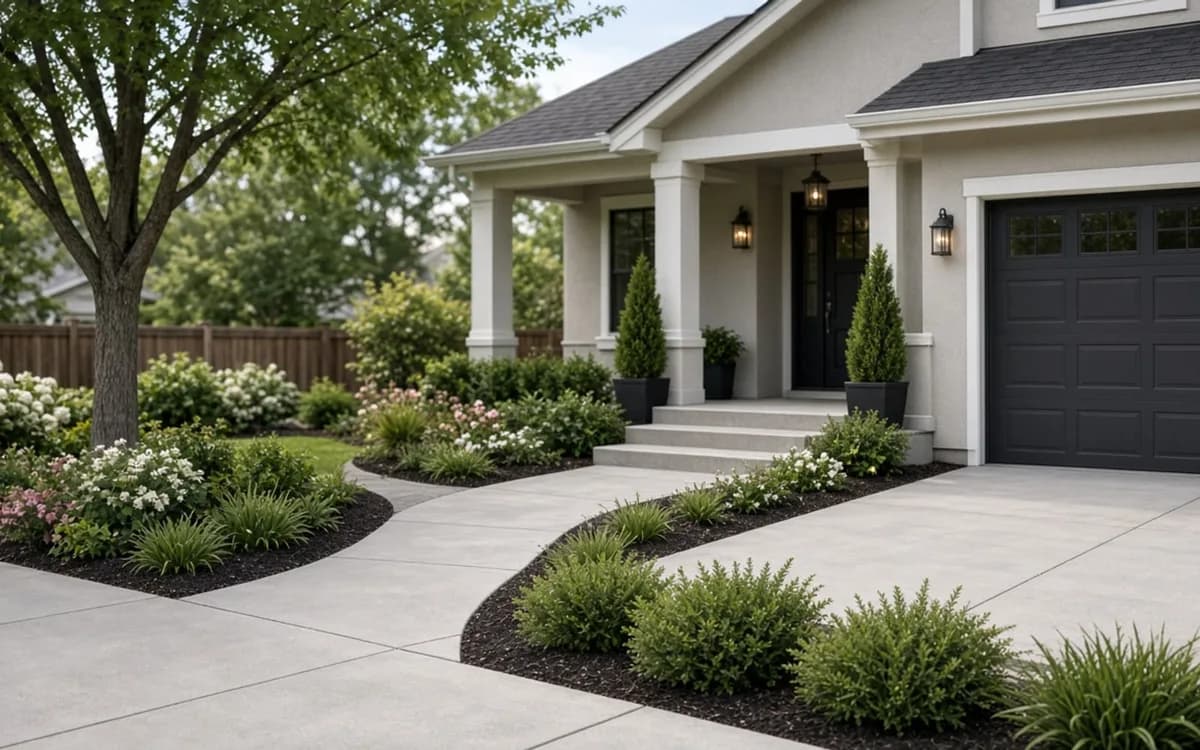
The EPA's construction figure for permeable interlocking pavers is $7 to $14 per sq ft, but residential quotes often run higher because the open-graded stone reservoir is deeper than a standard base and the washed aggregate costs more than dense-graded road base. On a driveway that can mean an extra 20 to 40 percent over a conventional paver drive. On a narrow walk the premium is smaller in dollars and rarely worth it unless the path sheds water toward the house.
The case for paying it is usually a rule, not a preference. Some municipalities cap impervious cover and exclude permeable surfaces from the count, and some offer stormwater credits. Virginia Cooperative Extension puts the service life at 20 to 30 years with maintenance, which means vacuuming the joints every year or two. Price that upkeep into the comparison on the permeable versus conventional page before signing.
Removal is the first. Breaking out an old concrete or asphalt driveway runs $550 to $1,700 on the page's table, more for thick or reinforced slabs, and a cracked front walk adds a few hundred dollars plus disposal. Steps are the second: a set of paver or block steps with a landing commonly runs $1,500 to $5,000 depending on rise and width, because each riser needs its own compacted footing and cut caps.
Drainage is the third and the one most often left out of low bids. A trench drain at the garage door with an outlet to daylight or a storm connection runs $800 to $2,500, and it is far cheaper during the build than after. Lighting sleeves, a heated snow-melt system, and a contrasting border are the remaining common extras. Snow-melt in particular can double the per-foot price, so ask for it as a separate line.
On most paver walks and drives, labor and equipment take 55 to 65 percent of the price. That share rises with curves, patterns and tight access, and falls on big rectangular driveways a skid steer can reach. Because labor dominates, the calendar matters: spring bids in busy markets carry the fullest schedules and the least room to negotiate, while late-season work in regions with mild autumns is often easier to book and sometimes cheaper.
Weather pushes costs too. A wet week on clay soil can mean over-excavating soft spots and adding geotextile, which should appear as a unit-priced allowance rather than a surprise. A driveway also takes the car out of service for several days, so plan parking and deliveries. HomeAdvisor puts the average paver driveway at $12,000, with most between $6,000 and $18,000, and pairing the front walk with the driveway is the obvious bundle here.
Local labor rates, soil and access will move each one, and the calculator lets you plug in your own area and tier. Use them to check whether a bid is in a plausible band and to decide which scope to request estimates for before you call anyone.
| Scope | Size | Planning range |
|---|---|---|
| Replace cracked front walk with concrete pavers | 4 x 30 ft (120 sq ft) | $1,900 to $3,600 including removal |
| Flagstone front walk with landing and two steps | 150 sq ft plus steps | $5,000 to $10,000 |
| Two-car paver driveway replacing asphalt | 600 sq ft | $8,000 to $17,000 including removal |
| Permeable paver driveway with trench drain | 600 sq ft | $12,000 to $24,000 |
| Driveway plus matching walk, one mobilisation | 600 + 120 sq ft | $10,000 to $20,000 |
Cut the decorative items before the structural ones. A contrasting border, a herringbone pattern instead of running bond, a premium tumbled finish, and a circle or inlay can together add 15 to 25 percent, and none of them affects how long the surface lasts. Dropping from natural stone to a stone-look concrete paver saves more. Phasing also works: build the driveway now and the garden paths next year.
Do not cut base depth, the 80 mm paver on vehicle areas, concrete edge restraint along the drive, or the drain at the garage. Those are the details whose absence shows up as ruts, spreading edges and ice at the door within a few winters, and repairing them means lifting the whole surface. If two bids differ by thousands, compare those four lines first; the full cost guide explains how to read the rest.
By the numbers
Planning figures from published U.S. sources; every card links to where the number came from.
$13 to $27 per sq ft
installed cost of a paver walkway (Lawn Love, December 2025)
A 100-square-foot front walk runs about $1,300 to $2,700. Concrete pavers are $7 to $16 per square foot in materials, clay brick $10 to $19 and natural stone $13 to $36.
Lawn Love, Paver Walkway Cost (2025)$12,000
average paver driveway, typical range $6,000 to $18,000 (HomeAdvisor, June 2026)
Installed cost spans $10 to $70 per square foot depending on material: concrete pavers $10 to $25, brick $10 to $45, natural stone $15 to $60, permeable $10 to $70. Removing an old driveway adds $550 to $1,700.
HomeAdvisor, Paver Driveway Cost Guide (2026)$7 to $14 per sq ft
construction cost of permeable interlocking pavers, which remove 67 to 81% of sediment (U.S. EPA)
EPA's stormwater fact sheet cites construction costs of $7 to $14 per square foot for PICP versus $3 to $9 for pervious concrete, with 67 to 81% total suspended solids removal. Some jurisdictions give stormwater-fee credits for permeable surfaces.
U.S. EPA, NPDES Stormwater Best Management Practice: Permeable Pavements (2021)100%
of a $9,000 flagstone walkway and planting upgrade recovered at resale (NAR 2023)
The NAR project spec was a 3-by-30-foot natural flagstone walkway with two stone planters, shrubs and a tree; Realtors estimated sellers get the full $9,000 back. Front-yard hardscape is one of the safest curb-appeal investments.
National Association of Realtors / NALP, 2023 Remodeling Impact Report: Outdoor Features (2023)The calculator uses the same patios and hardscapes benchmarks as this guide. Set the size and tier, then request a written estimate to check it against a real proposal.
Homeowner polls
No votes yet. Yours will be the first. · saved on this device
No votes yet. Yours will be the first. · saved on this device
No votes yet. Yours will be the first. · saved on this device
About $1,300 to $2,700 installed at Lawn Love's December 2025 rate, before removal of an old walk or any steps. Natural stone pushes the same walk to roughly $2,000 to $4,500. Curves, borders and tight side-yard access raise the per-foot figure because narrow work carries proportionally more edging and cutting.
Yes, usually by a wide margin up front. Asphalt is the cheapest surface and poured concrete sits between asphalt and pavers. Pavers cost more to install but can be lifted and relaid in sections, which lowers repair cost over time. Whether that trade pays depends on climate, how long you will stay and local labor rates.
A paver strip along one or both sides typically costs at the driveway rate per square foot plus a premium for the joint to the old surface, which needs a clean saw cut and a concrete edge. Small widenings of 100 to 200 square feet often land between $2,000 and $5,000 because mobilisation is spread over little area.
Usually a modest fee, often a few hundred dollars, but the work in the public right-of-way may have to meet city specifications for thickness and material, which can add concrete and labor. Some towns require a licensed or bonded contractor for curb cuts. Ask the building or public works office before the bid is finalised.
Hydronic or electric snow-melt commonly adds $15 to $30 or more per square foot installed, before the boiler or electrical service upgrade, and it has running costs. Many homeowners heat only the wheel tracks, the front landing and the steps. It must be designed before the base goes in; it cannot be added later without lifting the surface.
Together, with separate line items. One mobilisation, one equipment rental and one material delivery usually save several percent overall, and matching pavers from one production run avoids color mismatch. Separate lines let you phase one part later if the combined figure is too high, and they make comparing bids straightforward.
Plan for occasional joint sand top-ups, weed or moss control on shaded edges, and optional sealing every three to five years at HomeGuide's rate of $1.50 to $3.25 per square foot. Permeable driveways add annual or biennial joint vacuuming. Setting aside a small yearly amount covers relaying the occasional sunken paver.
 Paver Patio Installation · Cost guidePaver patio cost in 2026: what the per-square-foot number hides
A professionally installed paver patio costs $8 to $24 per square foot, per Lawn Love's December 2025 guide.
 Retaining Wall Construction · Cost guideRetaining wall cost in 2026: why height changes the price faster than length
A residential retaining wall costs $40 to $360 per linear foot in 2026 depending mainly on height, with HomeAdvisor's June 2026 average at $6,084.
 Fire Pit & Fireplace Install · Cost guideFire pit and outdoor fireplace cost in 2026: from a paver pad to a masonry chimney
An installed fire pit averages about $830 in 2026 per Lawn Love, with built-in pits at $1,000 to $3,000; an outdoor fireplace averages $3,000 per HomeAdvisor, with most between $1,500 and $8,000 and custom masonry far higher.
 Outdoor Living Spaces · Cost guideOutdoor living space cost in 2026: pricing a whole yard, one phase at a time
A coordinated outdoor living space in 2026 usually costs $25,000 to $80,000 or more, depending on how many zones it has and how much of the budget goes to vertical elements.
 Service guideWalkways & Driveways
Walkway and driveway work covers paths from the street or driveway to the door, garden paths, and vehicle surfaces in pavers, permeable pavers, concrete or stone.
Service guidePaver Patio InstallationPaver patio installation is the excavation, compacted stone base, bedding layer, laid pavers, edge restraint and joint fill that together create a level, drained outdoor surface.
Service guideRetaining Wall ConstructionRetaining wall construction turns a grade change into stable, usable ground with a footing, a wall of segmental block, stone, timber or poured concrete, and the drainage stone and pipe behind it.
 Free toolPatio cost calculator
Size, material tier and complexity in, a realistic budget range out.
 Free toolCompare hardscape options, row by row
Side-by-side tables for the decisions that change the price most.
 Free toolHardscape planning quiz
9 questions that show what you already know and what to check next.
 Free toolHardscape polls: how other homeowners are deciding
See what other planners chose and add your vote.
Tell us the size, the condition of what is there now, and what you want to change. Patio Scopebook passes your request to independent local professionals, who reply with written, no-obligation estimates. The service is free to use.